
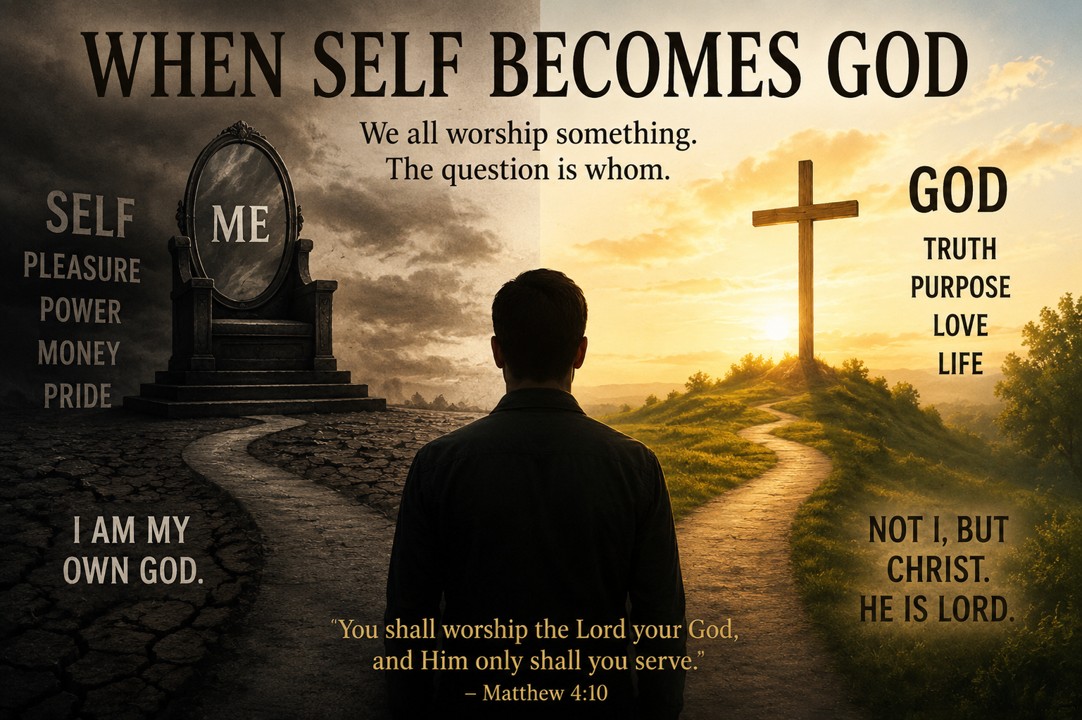
“I worship myself like you worship your God.”
That startling statement was made by a man named Levi during an online discussion involving Christians and Satanists. His words reveal something deeper than his particular religious choice. They expose one of the defining philosophies of our age: self-worship.
Levi described growing up in a Protestant church. His parents and grandparents were active members, and his family attended services every week. But he said his childhood interests in music and activities like Dungeons & Dragons were condemned as Satanic, and he felt labeled. Eventually, he decided to embrace that identity.
Levi explained his philosophy: Humans should look inward to find something worth worshiping. He described his belief system as a community focused on self-love and self-worth. He concluded, “I choose Satanism because Satan represents those values. God does not.”
His shocking admission reminds me of Paul’s words in 1 Corinthians 13:5: “Love is not self-seeking.”
There is nothing wrong with recognizing our God-given worth or learning to love ourselves appropriately. The problem comes when self-love becomes self-worship—when the creature takes the Creator’s place.
Levi’s philosophy is reminiscent of Paul’s description of the ancient Gentile world in Romans 1:20-25. They rejected the evidence of God, became futile in their thinking, and, while claiming to be wise, became fools. They “exchanged the truth of God for the lie, and worshiped and served the creature rather than the Creator.”
Notice the progression: They rejected God, exchanged truth for a lie, worshiped the creature, and suffered the consequences.
One may argue that Levi’s journey was influenced by an overly strict religious upbringing or insensitive judgments about his interests. Perhaps so. But ultimately, Levi himself acknowledged that embracing Satanism was his choice.
We are all given a choice to believe, obey, and serve God—or reject Him. He has provided abundant evidence of His existence. Even His divine nature is evident in creation, Paul declared.
Levi’s admission reflects a powerful current in secular culture—the conviction that the individual is the final authority for determining truth, morality, and meaning. “What’s true for you may not be true for me.” In essence, it says, “I am my own god.”
Of course, this is not new. The Old Testament era of the Judges was summarized in one sobering sentence: “Everyone did what was right in his own eyes” (Judg. 21:25).
Fulton J. Sheen expressed the principle well: “If you do not worship God, you worship something, and nine times out of ten it will be yourself.”
Everyone worships something or someone—even if it is yourself.
Self-exaltation ultimately leads us away from God. Sacred and secular history repeatedly records the sad consequences of individuals and societies that enthrone themselves. Romans 1 describes where that road leads: spiritual darkness, moral confusion, and increasing depravity.
But Jesus offers another way.
Peace, purpose, and the discovery of our true identity are found not in self-worship but in surrendering our lives to Christ. Jesus came so that we might know God, enjoy a relationship with Him, and experience life in its fullness (Jn. 10:10).
His way is rooted in the two great commandments: love God with all our being and love our neighbor as ourselves (Matt. 22:37-40). It is expressed in the Golden Rule: treating others as we want to be treated (Matt. 7:12).
Thomas Brooks wrote, “Self-seeking blinds the soul.” How true.
The real question is not whether we worship. We all worship. The question is whom we worship.
Is self sitting on the throne? Or is God?
–Ken Weliever, The Preacherman

