
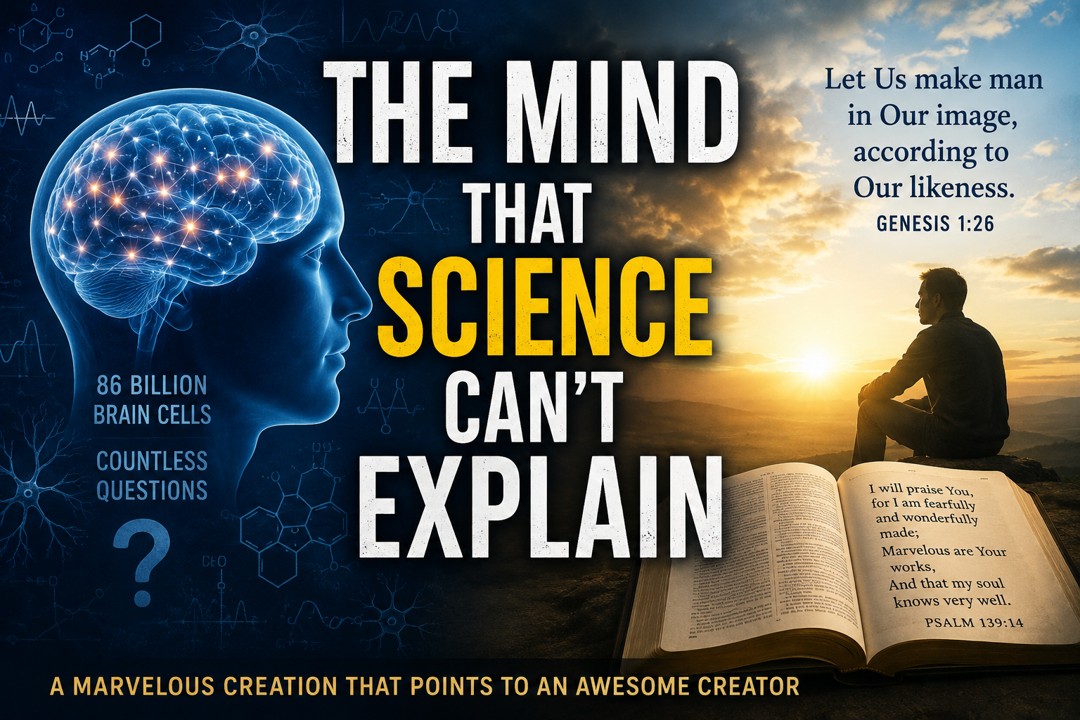
What is consciousness? How do you define it? Where did it originate?
Those questions may not occupy our daily thoughts, but they continue to puzzle some of the world’s brightest scientists.
In a recent Scientific American article, “What Is Consciousness? Science Faces Its Hardest Problem Yet,” Allison Parshall explores a mystery that remains unsolved. Researchers know the brain contains some 86 billion neurons, yet they cannot explain how those cells give rise to the conscious mind—our awareness, identity, and sense of self.
The article makes several revealing admissions. Scientists cannot even agree on a basic definition of consciousness. Competing theories continue to clash. Experimental results challenge long-held assumptions. Despite decades of research and enormous advances in neuroscience, the origin and nature of consciousness remain elusive.
One researcher compared the human brain to an ordinary object with the texture of tofu, yet somehow containing “an entire universe.” Another observed that no amount of research funding could guarantee an answer. Still another questioned the popular view that the brain functions merely as a biological computer.
It’s both fascinating and ironic that science continues to struggle with one of God’s most marvelous creations—the conscious mind. The more researchers learn about the brain, the more mysterious consciousness seems to become.
The Bible begins from an entirely different starting point. Rather than assuming consciousness emerged through undirected processes, Scripture reveals that our ability to think, reason, choose, and reflect flows from our Creator.
God declared,
“Let Us make man in Our image, according to Our likeness” (Gen. 1:26-27).
The psalmist celebrated this truth:
What is man that You are mindful of him,
And the son of man that You visit him?
For You have made him a little lower than the angels,
And You have crowned him with glory and honor.
(Psalm 8:4-5)
While we do not possess God’s omniscience, omnipotence, or omnipresence, we bear His image in remarkable ways. We can love, reason, create, show mercy, exercise wisdom, build relationships, and make moral choices. We can even think about our own thinking.
Perhaps that’s one of the greatest gifts God has given us: the power to choose.
Author and psychologist Dr. J. Martin Kohe expressed it well: “The greatest power a person possesses is his power to choose.”
Wayne Grudem, professor of theology and Biblical studies, likewise reminds us, “The fact that man is in the image of God means that man is like God and represents God.” That likeness includes our moral, intellectual, relational, and spiritual capacities.
Because God has given us a conscious mind, we are responsible for how we cultivate it.
James Allen captured that truth in his classic As a Man Thinketh:
“A man’s mind may be likened to a garden, which may be intelligently cultivated or allowed to run wild.”
He went on to explain that just as a gardener removes weeds and nurtures healthy plants, we must weed out impure, harmful thoughts while cultivating those that are true, noble, and good. In doing so, we shape our character and, ultimately, the direction of our lives.
The apostle Paul expressed the same principle centuries earlier when he urged Christians to think on “whatever things are true… noble… just… pure… lovely… and of good report” (Phil. 4:8).
Science will undoubtedly continue exploring the mysteries of the brain. It should. Such study can deepen our appreciation for the intricacy of God’s creation. But the existence of consciousness ultimately points beyond neurons and synapses to the One who fashioned us in His image.
As David reflected on God’s marvelous workmanship, we can joyfully echo his words:
I will praise You, for I am fearfully and wonderfully made;
Marvelous are Your works,
And that my soul knows very well.
(Psalm 139:14)
—Ken Weliever, The Preacherman


Thanks, brother, for your continued work in sharing God’s word through daily devotionals. I marvel at your ability to do this on a daily basis. I “look up to you” in more than one way.
LikeLiked by 1 person
Thanks. I appreciate your kind words. And I’m glad you find them helpful. Thanks for being a regular reader.
LikeLike
Pingback: Weekly Recap: July 27-31 | ThePreachersWord