
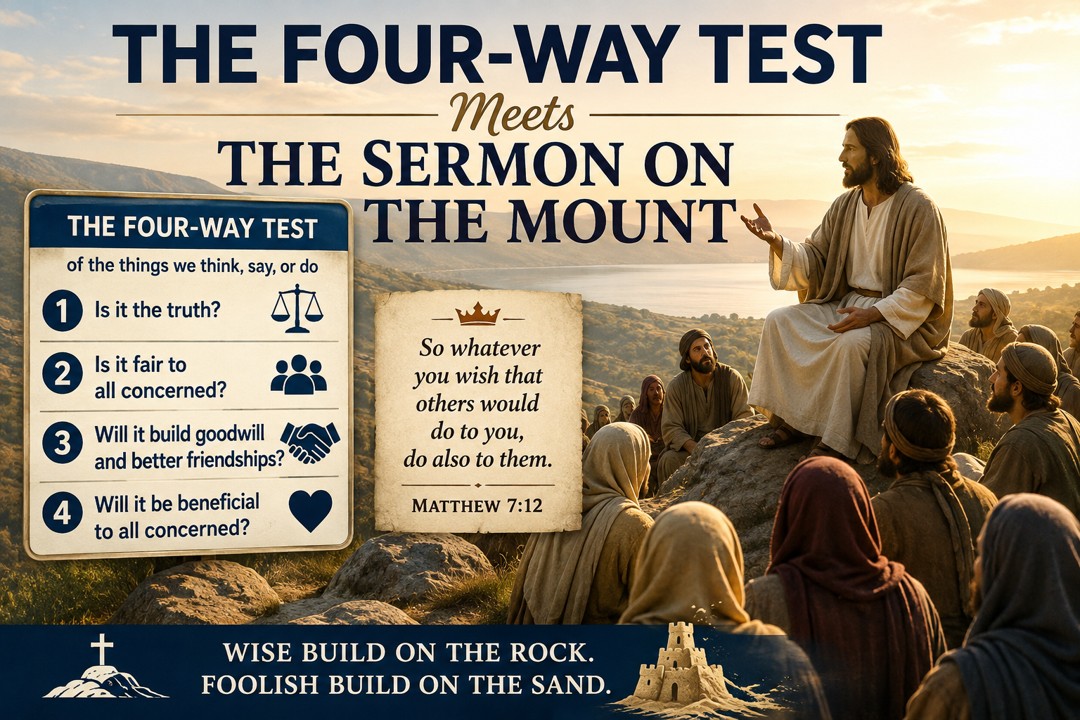
Yesterday was my weekly Rotary meeting. We began, as always, with an invocation, the Pledge of Allegiance, and the recitation of The Four-Way Test.
Created in 1932 by Rotarian Herbert J. Taylor while trying to rescue a struggling company during the Great Depression, The Four-Way Test asks four simple questions that pertain to business ethics regarding the things we think, say, or do.
- Is it the truth?
- Is it fair to all concerned?
- Will it build goodwill and better friendships?
- Will it be beneficial to all concerned?
As I’ve recited those four questions for the past 29 years, it struck me yesterday how closely they echo many of the principles Jesus taught in Matthew 5-7, known as the Sermon on the Mount.
While the Four-Way Test speaks to general principles, Jesus’ timeless message offers specific applications. He begins with the Beatitudes, describing the character of those who belong to His Kingdom, and then shows how those qualities are lived out in everyday relationships.
What if our “yes” always meant yes and our “no” meant no? No equivocation. No double-talk. No stretching the truth. (Matt. 5:33-37).
What if our outward speech simply reflected hearts of integrity, free from hypocrisy, manipulation, and impure motives? (Matt. 6:1-4).
Imagine practicing the Golden Rule in every relationship: “So whatever you wish that others would do to you, do also to them, for this is the Law and the Prophets” (Matt. 7:12).
Suppose we became known as peacemakers instead of conflict-makers—resolving disputes and seeking reconciliation. (Matt. 5:9, 23-25).
What if we were selfless in our giving? Willing to go the extra mile? Giving generously with no ulterior motive? (Matt. 5:38-42).
What if we refrained from censorious, hypercritical, and hypocritical judgment? (Matt. 7:1-5). Applying this one command would meet the criteria of the entire Four-Way Test. Furthermore, it would make our homes happier, our churches stronger, and our businesses operate more smoothly.
Overcoming worry, extending forgiveness, respecting the sanctity of marriage, doing good, being a light to others, and even loving our enemies all find practical application in Jesus’ sermon. (Matt. 6:25-34; 6:14-15; 5:13-16; 5:43-48).
Of course, the Sermon on the Mount goes far beyond a code of ethics, a creed for growing a business, or a guide for improving relationships. Unlike the Four-Way Test, Jesus’ message is profoundly spiritual. It speaks to those who would be His disciples and describes the character of the citizens who comprise His Kingdom.
The Four-Way Test can help make someone a better employee, employer, neighbor, or citizen. The Sermon on the Mount does something far greater. It transforms the heart, prepares us for citizenship in God’s Kingdom, and points us toward eternity.
I know little about Herbert J. Taylor’s personal faith. But, interestingly, a moral code written to improve earthly relationships reflects many of the very principles Jesus taught nearly 2,000 years ago. Though not quoted directly, the values of the Sermon on the Mount are echoed every week in Rotary clubs around the world.
It’s a reminder that the best possible life on earth can be realized by following Jesus. But more than that, it’s the roadmap to walk “the narrow way” that leads from earth to heaven.
If you haven’t read the Sermon on the Mount recently, take 16 minutes and read it again. Or listen to it on YouTube.
You may be like those who heard it for the first time and “were astonished at His teaching.”
And don’t miss Jesus’ final parable. Those who hear His words and obey them are like the wise man who built his house on solid rock. Those who reject His teaching build on shifting sand. When the storms come—and they will—the foundation makes all the difference (Matt. 7:24-27).
The Four-Way Test offers wise principles for living. But the Sermon on the Mount calls us to something infinitely greater—to become faithful disciples of the King. That’s the difference between simply living a better life and finding the abundant life here and eternal life hereafter.
–Ken Weliever, The Preacherman


Dear Ken, I sure appreciate these and the effort you make to get them out daily. I think of you and Norma Jean often. I hope she is doing well and is not having too much discomfort. You are both in my thoughts and prayers. Hold fast to our Father, His Son and Spirit and may His will be done in our lives, Wendy Etheridge-Fretter wendyworks247@gmail.com
LikeLike
Pingback: Weekly Recap: August 3-7 | ThePreachersWord