
“He is rich or poor according to what he is, not according to what he has,” once observed the 19th-century American minister Henry Ward Beecher.
His quote is reminiscent of a line from a more recent preacher who said, “We are rich in the things that perish, but poor in the things of the spirit. We are rich in gadgets, but poor in faith. We are rich in goods, but poor in grace. We are rich in know-how, but poor in character. We are rich in words, but poor in deeds.”
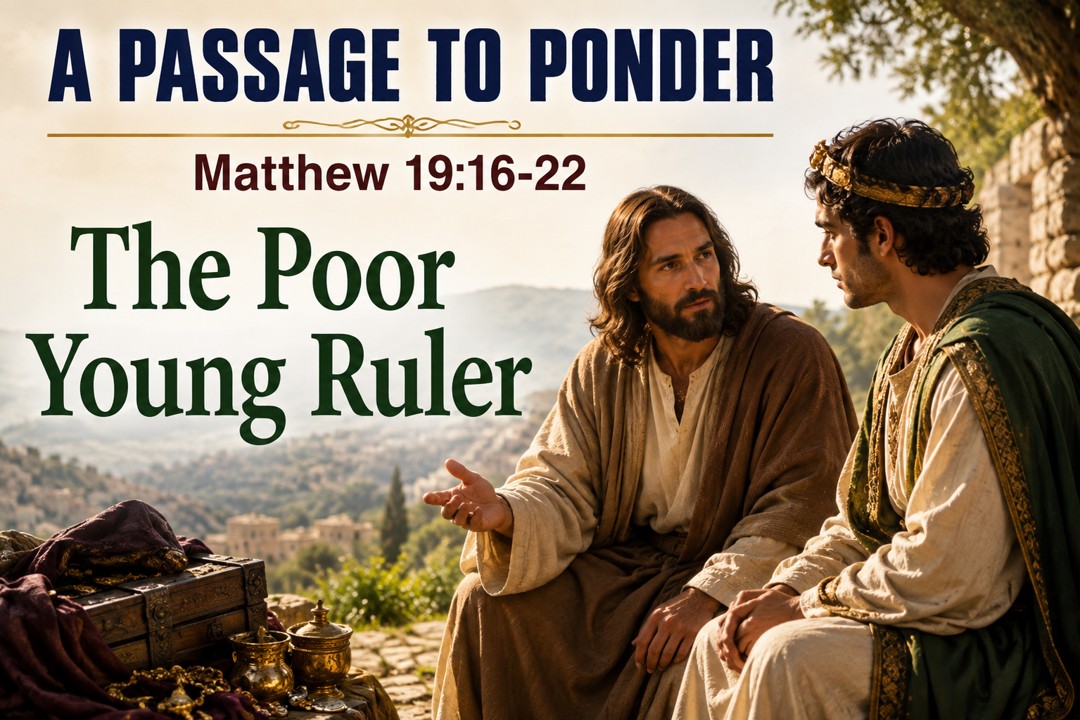
If those observations are true, perhaps the man in today’s text should be remembered not as The Rich Young Ruler, but as The Poor Young Ruler. Though he possessed great wealth, he lacked the one treasure that mattered most.
It’s a familiar narrative, recorded by all three Synoptic Gospel writers, about a young man who came to Jesus, seemingly sincere in his desire to become His disciple. Matthew records the encounter in four revealing moments.
The Question: “Teacher, what good deed must I do to have eternal life?”
The Command: Jesus pointed him to the Mosaic commandments, which he claimed to have kept since his youth. Then he asked, “What do I still lack?”
The Challenge: Jesus told him to sell his possessions, give the proceeds to people experiencing poverty, and follow Him.
The Response: Upon hearing this, the young man became sad because he had “great possessions.” He declined Jesus’ challenge and turned away with “great sorrow.”
The young ruler began well. He came to the right Person. He asked the right question. He recognized his personal responsibility. Yet he made the wrong choice.
He possessed everything our culture admires—youth, influence, status, and wealth. Yet Jesus exposed what no one else could see. Beneath all those blessings was a heart divided by one great attachment.
Consider four lessons we can learn from this account.
#1 Good Works Alone Cannot Earn Salvation
Jesus first directed the man’s attention to God’s perfect goodness, reminding him that no one measures up to that divine standard. Furthermore, the “one thing” went far beyond a single act or deed that could be checked off a list of good works.
Grace reminds us that we cannot earn our salvation. Yes, we obey God because we love Him and desire to please Him. Yet even then we remain “unprofitable servants,” having merely done our duty (Luke 17:7-10).
#2 Idolatry Prevents True Discipleship
Jesus knew the young man’s heart and understood his weakness. The “one thing” was not another deed to perform, but an idol he needed to forsake. Jesus’ command was not a universal rule requiring every disciple to become destitute. However, every disciple must surrender whatever stands between himself and God.
Our idol may not be wealth. It may be pleasure. Power. Position. Or a relationship that has become more important than our communion with God.
The issue was never the man’s money—it was his master. Jesus simply revealed whom he truly loved.
#3 Wealth Can Create a Spiritual Barrier
Not everyone can handle riches. For some, wealth provides a false sense of security and self-sufficiency. It can become a snare that leads people into foolish and harmful desires (1 Timothy 6:9-10).
Let us be careful, however, that we don’t point fingers at billionaires while overlooking our own prosperity. As Americans, even our middle-class comforts and relative ease can become just as great a stumbling block as immense wealth is for the super-rich.
#4 Sacrificial Giving Has Eternal Rewards
In contrast to the ruler who sorrowfully walked away, Jesus promised that those who willingly forsake earthly treasures, comfort, or even family for His sake will receive “a hundredfold” and inherit eternal life (Matthew 19:29).
Therefore, we must never become arrogant or place our confidence in the uncertainty of riches, but in the living God. As Paul instructed in 1 Timothy 6:17-19, we are to do good, be rich in good works, be generous, and be ready to share. In doing so, we lay up treasures in heaven.
The young man’s question is one every disciple ought to ask: “What do I still lack?”
But be careful if you ask it. Jesus may lovingly put His finger on the very thing you’ve been unwilling to surrender.
Whatever that “one thing” is-it’s costing you far more than it’s worth.
—Ken Weliever, The Preacherman


We just have to be careful we don’t find ourselves blind to the one thing that is keeping us from doing all we should be doing.
LikeLike
Pingback: Weekly Recap: August 3-7 | ThePreachersWord