
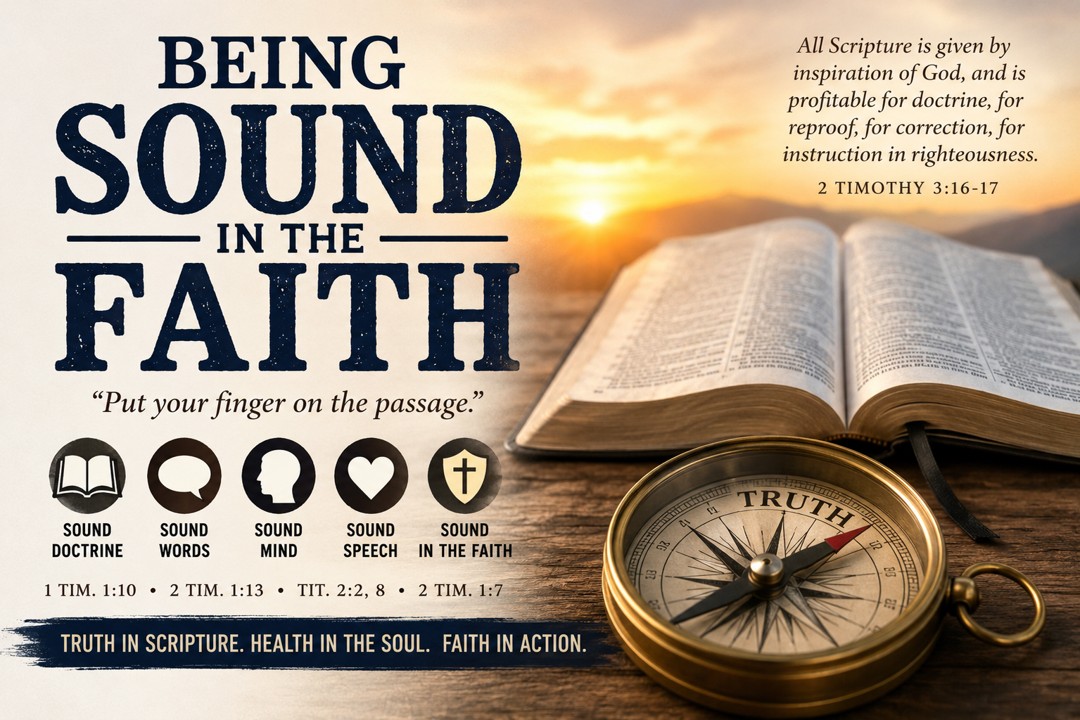
The late Robert Jackson was one of my mentors as a young preacher. He used to preach a sermon in meetings he called “Put Your Finger on the Passage.”
As I recall, Robert would introduce ideas that folks had about the Bible, some accurate and some inaccurate, and then say, “Put your finger on the passage.”
He would then open the Bible and read what God said about the issue. Whether the topic was salvation, worship, or the church, Robert’s challenge was simple: Put your finger on the passage. If the Bible taught it, embrace it. If Scripture did not support it, reject it.
This was Robert’s way of underscoring an old Restoration plea for Bible authority often echoed in the phrase, “Give me book, chapter, and verse.” This slogan and Robert’s sermon have a scriptural basis in the use of the word “sound” in Paul’s epistles.
In his letters to Timothy and Titus, Paul often uses the word “sound” to identify the importance and accuracy of truth. “Sound doctrine” (1 Tim. 1:10). “Sound in the faith” (Tit. 2:2). “Sound words” (2 Tim. 1:13). “Sound speech” (Tit. 2:8). “Sound mind” (2 Tim. 1:7).
In years past, I’ve heard the word “sound” used to ask, “Is this a sound church?” Often, the definition of “sound” was narrowed to one or two prominent issues in the brotherhood. Those matters may be important, but the biblical concept of soundness is much broader than a single issue or area of concern.
The word “sound” means healthy. Thayer says it means “to be well, to be in good health.” It is used metaphorically to speak of spiritual health.
A physician does not determine a person’s health by examining only one part of the body. Likewise, God does not measure spiritual health by one isolated doctrine or practice. Just as physical health depends on a variety of factors, so does spiritual health.
Too often, we define our spirituality by what we don’t do. How we’re not like the world. Or we may look at a church and compare it to another church that is not following the Bible.
However, being spiritually healthy is not defined simply by the absence of error or sin, but by what we do. How are we living? Not just what we believe, but what we practice. It digs deeper into motives. It examines the condition of the spiritual heart.
It is possible to be sound in our arguments and unsound in our attitudes. It is possible to defend truth while failing to demonstrate the love, humility, and compassion that truth produces.
“Sound doctrine” and “sound teaching” must obviously be based on Scripture. I’ve heard people say they visited a church where the preacher never read a single Bible verse. How can such teaching be healthy?
I’ve had people justify doctrinal positions not found in the Bible by saying, “Well, that’s our tradition.” How is that healthy?
Often, churches change positions on moral issues, arguing that society has changed and the old practice is no longer accepted. But if the new practice violates Scripture, isn’t that unhealthy?
Views on marriage have shifted dramatically in my lifetime. But has the Bible changed? Do the prevailing practices socially approved conform to “sound doctrine”?
Furthermore, a church may be called “sound” not merely because it conforms to a few commonly discussed issues, but because it teaches, preaches, and practices what the Bible says in all areas. Sadly, some churches are sound asleep to the current issues and challenges of the 21st century.
Some shepherds are sound asleep regarding their feeding, protection, leadership, and vision for the flock of God under their care (Acts 20:28-32).
Some preachers are sound asleep to their responsibility to “preach the Word” (2 Tim. 4:1-2), not personal opinions, political agendas, or human traditions.
Some Christians are sound asleep to their discipleship duties “to grow in the grace and knowledge of the Lord Jesus Christ” (2 Pet. 3:18).
Some parents are sound in providing for their children’s physical needs, but neglect the greater responsibility of spiritual training (Eph. 6:1-4).
We need to put our finger on the passage for what we believe if we want to embrace sound doctrine. But it is just as important to practice what we profess if we want to live a spiritually healthy life.
The greatest danger may not simply be being unsound. It may be that we believe we are sound while we have become spiritually asleep.
What about you? Are you sound in the faith?
Ken Weliever, The Preacherman


Pingback: Weekly Recap: June 22-26 | ThePreachersWord