
Ralph Waldo Emerson, the 19th-century essayist, poet, and philosopher, wrote a great deal about the importance of thinking for oneself. He once lamented that “the problem with men today is that they don’t think.”
Thomas Edison echoed this sentiment when he opined, “Five percent of the people think; ten percent of the people think they think; and the other eighty-five percent would rather die than think.”
And Helen Keller spoke an uncomfortable truth when she said, “People don’t like to think; if one thinks, one must reach conclusions. Conclusions are not always pleasant.”
Jesus frequently asked people, in response to His teaching, “What do you think?” (Matt. 17:25; 18:12; 22:42). His goal was to challenge their preconceived ideas, misconceptions, and shallow thinking. He wanted people to open their eyes to different possibilities. New ideas. And a different life.
To think is to reflect. To consider. To conceive. To analyze. To evaluate. To employ one’s mind rationally. The ability to think, reason, reflect, and make moral judgments is part of what distinguishes us as beings made in God’s image.
Good thinking begins with God. His Word. And His revelation. Man’s thoughts, void of God and godliness, become futile. The wise man wrote, “The thoughts of the righteous are right” (Prov. 12:5). And Jesus warned that evil thoughts can produce evil deeds (Matt. 15:19).
Our thinking ultimately influences the kind of person we become. It was Emerson who wrote, “A man is what he thinks about all day long.” However, this wasn’t a new thought. The second-century Roman Emperor Marcus Aurelius said, “A man’s life is what his thoughts make of it.”
Centuries before either man, the Bible repeatedly emphasized the importance of the heart—our inner thoughts, motives, desires, and attitudes. Solomon admonished, “Keep your heart with all diligence, for out of it spring the issues of life” (Prov. 4:23).
Twenty-nine centuries later, an obscure author, James Allen, would write a book entitled As a Man Thinketh. In it he stated, “Thought and character are one.” He further developed the connection between thought and character in these words:
“Man is made or unmade by himself. In the armory of thought, he forges the weapons by which he destroys himself. He also fashions the tools with which he builds for himself heavenly mansions of joy and strength and peace. By right choice and true application of thought, man ascends to divine perfection. By the abuse and wrong application of thought, he descends below the level of beast. Between these two are all the grades of character, and man is their maker and master.”
Indeed, our thoughts help determine our character. They shape our attitudes. Influence our choices. And often precede our actions.
It is important to realize that God cares about what we think. Good thinking is about more than improving our lives. It is also about pleasing God. And it must be guided by His Book.
I heard the late Ed Harrell once relate a story about a young man who was prone to some speculative religious thinking, justifying it by saying he was “thinking outside the box.”
Ed quipped, “Before you can think outside the box, you need to know what’s inside the box.”
For the Christian, the Bible defines the boundaries of the box.
God not only commands us to think; He tells us what is worthy of our thoughts.
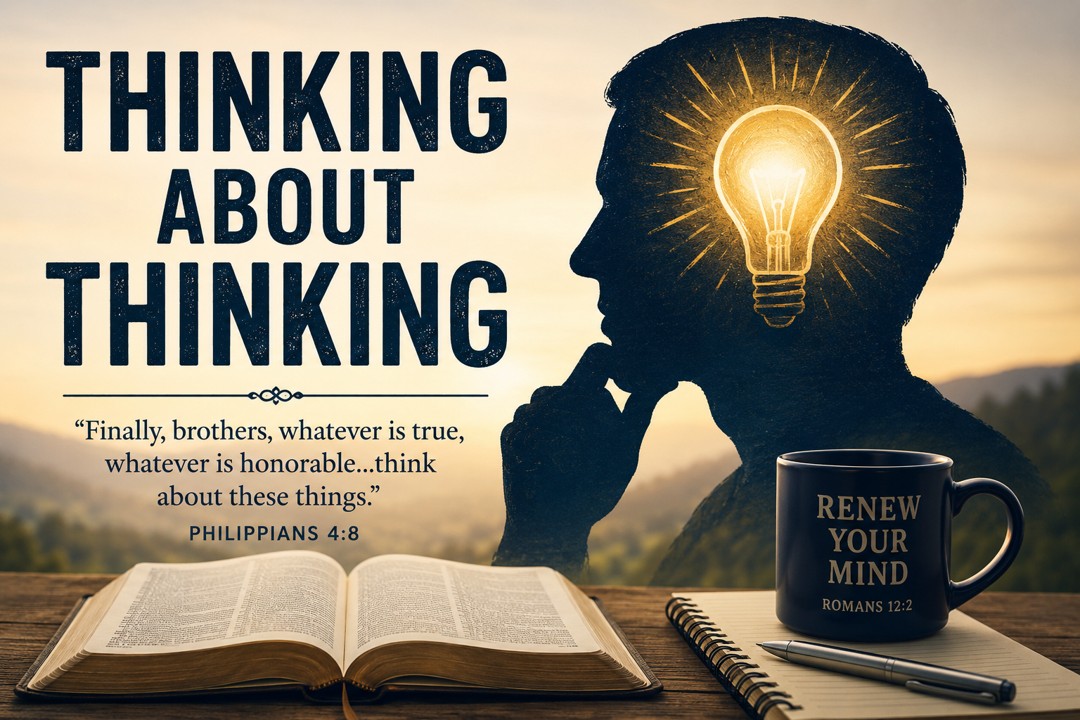
“Finally, brothers, whatever is true, whatever is honorable, whatever is just, whatever is pure, whatever is lovely, whatever is commendable, if there is any excellence, if there is anything worthy of praise, think about these things” (Phil. 4:8).
What do you think?
–Ken Weliever, The Preacherman


Pingback: Weekly Recap: August 31-September 4 | ThePreachersWord