
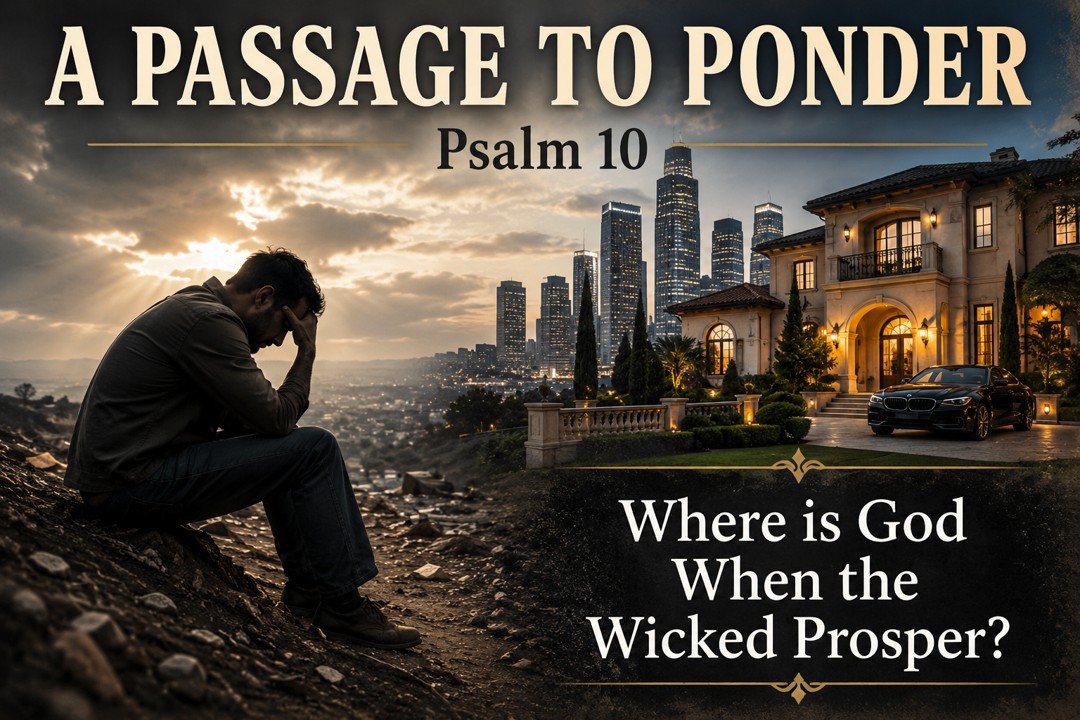
Imagine two employees. One works hard, keeps his word, treats people fairly, and does the right thing. The other cuts corners, takes credit for someone else’s work, manipulates people, and breaks the rules. Yet somehow the dishonest employee gets the promotion, the corner office, and the bigger paycheck.
We have all seen some version of that in reality.
Psalm 10 speaks to that very issue. It’s the age-old question raised by C. S. Lewis when he wrote about his personal heartbreak in A Grief Observed: “Where is God?”
Questioning God
“Why, O LORD, do you stand afar off? Why do you hide yourself in times of trouble?” the Psalmist asks.
David’s question is one of perplexity, not unbelief. He doesn’t doubt God’s existence, or even His power and presence. Yet, in essence, he wonders, “If I were God, I would have made the world differently.”
Why does God allow the wicked to prosper? Why do the innocent suffer? Why does God sometimes seem silent when His people are hurting?
Rejecting God
The Psalmist then observes what was obvious among the unbelievers of his day. There is injustice. Iniquity. Inequity. The innocent suffer, and the poor are persecuted.
Yet the wicked prosper.
They are arrogant, boastful, ungodly, and uncaring. They are cold and calculated in their sinister schemes. There is no shame. No guilt. No contrition.
Filled with greed and guile, they claim, “There is no God.” They feel above any consequences when they boast, “I shall not be moved.” They believe they are beyond Divine judgment.
Sound familiar?
Trusting God
Like many of David’s psalms, he moves from questioning, to lament, to trust in God’s providence.
Regardless of why God doesn’t act when he thinks He should, David believes that God sees what is going on. He acknowledges that God is Lord and King. He knows that God will one day judge the wicked and that they will pay for their sins. And he trusts that God ultimately will come to the defense and aid of His people.
Our World Today
While this was written 3,000 years ago, it reads like today’s commentary on cable news.
Unless you’ve been emulating Rip Van Winkle, you have heard, seen, and maybe even personally experienced some of the same problems described in this Psalm.
The nature of mankind hasn’t changed much. Oh, we have advanced technology, modern conveniences, and access to information at our fingertips. But wicked people still commit evil acts. They are too evident and obvious and need no elaboration.
Our challenge as Christ-disciples is not to allow the evil around us to influence us, discourage us, cause us to fall into despair, or even tempt us to doubt God.
Biblical history reminds us of the eternal principle Paul enunciated in Galatians 6:7-8:
“Do not be deceived, God is not mocked; for whatever a man sows, that he will also reap. For he who sows to his flesh will of the flesh reap corruption, but he who sows to the Spirit will of the Spirit reap everlasting life.”
God will ultimately judge the wicked and reward the righteous. But it will be “in His time.”
Our duty is to be faithful.
And let God be God.
There’s an old hymn that speaks to this issue:
Tempted and tried, we’re oft made to wonder
Why it should be thus all the day long
While there are others living about us
Never molested though in the wrong
But the hymnist reminds us:
Farther along we’ll know all about it
Farther along we’ll understand why
Cheer up my brother, live in the sunshine
We’ll understand it all by and by
That may sound simplistic. But it is scriptural. And it’s true.
Don’t fret. Worry. Or doubt.
Hold on tight to your faith. Pray. Worship. Trust God. And shine your light in the sin-darkened world that desperately needs it.
Although “Troublesome times are here,” as another hymn reminds us, it also offers this Biblical hope:
Troubles will soon be o’er; happy forevermore,
When we meet on that shore, free from all care.
Rising up in the sky, telling this world goodbye;
Homeward we then will fly, glory to share.
—Ken Weliever, The Preacherman


Pingback: Weekly Recap: August 10-14 | ThePreachersWord