
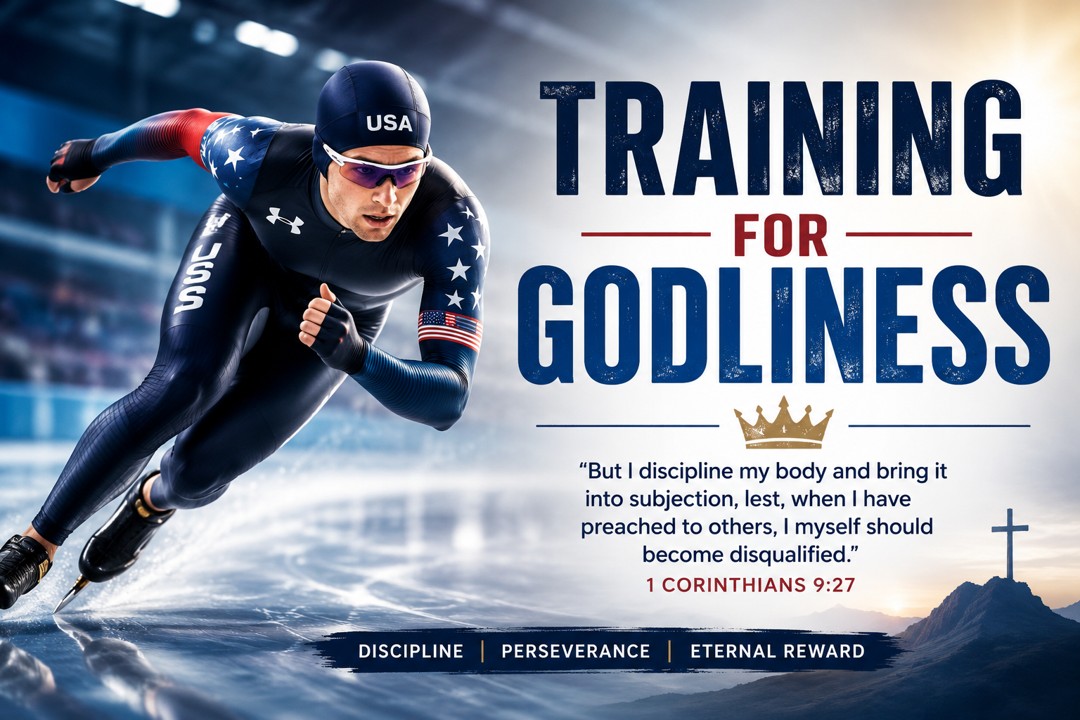
“Why Spiritual Growth Requires Hard Training?” was a piece in CT that caught my eye.
It told the story of 21-year-old American Jordan Stolz, who won two gold medals and one silver in speed skating at the Winter Olympics, becoming the first U.S. athlete to win three medals in the Winter Games since 2010.
Stolz’s success took on an added dimension when he revealed that he had persuaded Bob Corby, a 75-year-old retired coach, to return to the rink and train him.
Corby was old school. Rather than chasing the latest training trends, he prioritized high-volume endurance work combined with heavy strength training.
Stolz’s rigorous training, which pushed his physical limits, paid off when he had the strength and endurance others lacked late in the race, capturing gold in the 1,000 meters.
Currently, I’m writing Bible class material for the adult VBS class in Wellandport, Ontario, that I will be teaching this summer. In connection with their theme, based on sports metaphors from Scripture, my title is “Developing the Heart of a Spiritual Champion.”
As I read Stolz’s story, I couldn’t help but think about the first two lessons I am preparing on Discipline and Perseverance, built around Paul’s use of athletic imagery to describe the Christian life.
In 1 Corinthians 9:24-27, the apostle penned:
“Do you not know that those who run in a race all run, but one receives the prize? Run in such a way that you may obtain it. And everyone who competes for the prize is temperate in all things. Now they do it to obtain a perishable crown, but we for an imperishable crown. Therefore, I run thus: not with uncertainty. Thus I fight: not as one who beats the air. But I discipline my body and bring it into subjection, lest, when I have preached to others, I myself should become disqualified.”
No athlete drifts into excellence. Championships are not won accidentally. They are earned through daily habits, disciplined choices, and a willingness to do what others are unwilling to do. It takes hard work. Persistence. Perseverance. Discipline. And not just the will to win, but the will to prepare.
It’s not only true athletically, but true spiritually. No Christian drifts into spiritual maturity. Discipline is developed daily through intentional choices—through the commitment to study, learn, grow, and say “no” to choices that impede your progress.
Our culture too often seeks the easy way. Get-rich schemes entice people with the false hope of little or no work. These are empty promises. Successful athletes achieve their success through countless early morning hours spent training while others are still sleeping. There’s no shortcut to success in life, in sports, or in Christian growth.
Too many Christians are like the fellow who visited the bookstore and asked the clerk, “Do you have a book titled Christianity Made Easy?”
There is no such book. And if there were, it would be misleading. “The Book,” the Bible, calls for discipline, cross-bearing, commitment, and daily discipleship in following Jesus.
Jesus said, “If anyone desires to come after Me, let him deny himself, and take up his cross daily, and follow Me. For whoever desires to save his life will lose it, but whoever loses his life for My sake will save it.”
Self-denial and daily discipline are needed not only for the Olympic champion but also for the spiritual champion.
In another sports analogy, Paul expressed it in these words:
“Brethren, I do not count myself to have apprehended; but one thing I do, forgetting those things which are behind and reaching forward to those things which are ahead, I press toward the goal for the prize of the upward call of God in Christ Jesus.” (Phil. 3:13-14).
“Reaching forward,” rendered in some translations as “straining forward,” pictures an athlete stretching toward the finish line with every ounce of effort. Paul was pressing on with all his might. Even while imprisoned and awaiting trial, he continued writing, preaching, teaching, influencing others, and keeping his eyes fixed on the heavenly goal.
The apostle was right when he wrote to Timothy: “Exercise yourself toward godliness. For bodily exercise profits a little, but godliness is profitable for all things, having promise of the life that now is and of that which is to come.”
We admire and applaud the success of athletes like Jordan Stolz. But remember, he paid the price to win the prize. Likewise, if we hope to finish the Christian race victoriously, we must be willing to pay the price of spiritual training. There are no shortcuts to godliness and no substitutes for discipline. We must train ourselves spiritually to be disciplined. To persevere. To stay spiritually focused. And press on with passion toward the heavenly prize.
One day, earthly awards, medals, and trophies will be left behind. But the crown of life will endure forever as we enjoy our heavenly reward. As the hymn writer W. Oliver Cooper so beautifully expressed it, “Surely heaven will be worth it all.”
–Ken Weliever, The Preacherman


I would love to have a copy of the adult VBS study We just finished VBS and mentioned why not have a standalone ADULT VBS At least I am thinking with you. “Make today so good that yesterday is jealous” “Keep the FAITH and win the FIGHT”! <*}}}><
LikeLike