
While we have been on our blogging break, we’ve again been reminded how easily people justify violence—even in the name of faith.
A recent act of political violence involved a highly educated young man who targeted a member of a presidential administration. In a manifesto sent to family members just minutes before the attack, he listed numerous grievances and attempted to frame his actions as a defense of the oppressed—even appealing to Christian reasoning.
“Objection 1,” he wrote, “as a Christian, you should turn the other cheek.”
“Turning the other cheek is for when you yourself are oppressed,” he argued. “Turning the other cheek when someone else is oppressed is not Christian behavior; it is complicity in the oppressor’s crimes.”
He also referenced Jesus’s command in Matthew 22:21 to “render unto Caesar what is Caesar’s,” suggesting that if political leaders fail to follow the law, they forfeit any rightful authority.
Despite what appears to be confusion about the teachings of Christ, his document also expressed affection for his church family. Some observers have even described him as a “zealot”—a term used by the Jewish historian Josephus to describe those who violently opposed Roman rule.
Yet, such reasoning is not consistent with Scripture.
Jesus did not place qualifications on His command to “turn the other cheek.” In fact, He went further—teaching His followers to “go the second mile,” a reference to Roman soldiers who could compel someone to carry their load for a mile. Rather than resist, Jesus instructed His disciples to do more than what was demanded.
Likewise, the command to “render unto Caesar” was given in the context of paying taxes to a corrupt government under immoral rulers. The depravity of Roman culture and many of its emperors is well documented. Still, Jesus called for submission in matters that did not violate God’s will.
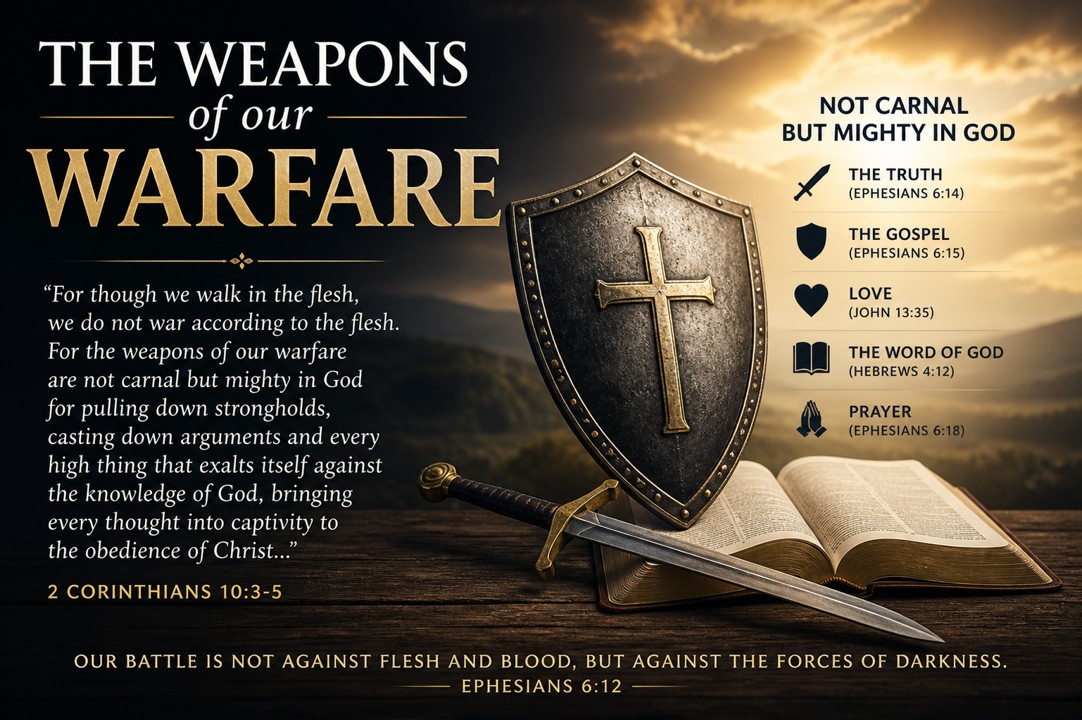
The apostle Paul reinforces this principle in 2 Corinthians 10:3–5:
“For though we walk in the flesh, we do not war according to the flesh. For the weapons of our warfare are not carnal but mighty in God for pulling down strongholds, casting down arguments and every high thing that exalts itself against the knowledge of God, bringing every thought into captivity to the obedience of Christ…”
This passage forbids physical, carnal warfare. There is no place for Christians to become physically aggressive or resort to acts of violence under the guise of defending the oppressed.
While it’s difficult to imagine true Christians engaging in the type of violent aggression like this assailant, too many have allowed their passion, both on the right and the left, to degenerate into carnal tactics. Spewing angry epithets, spouting unkind words, and “slinging mud” at our opponents are carnal, fleshly tactics. They do a disservice to the cause of Christ. We would all do well to remember that the next time we engage in a Facebook discussion.
The answer to the world’s problems is not political change, but spiritual conversion.
Our country is very polarized politically right now. Unfortunately, that spirit has infiltrated many Christians. While it is everyone’s right to make personal choices regarding candidates for political office, let’s not become so enamored with “our guy” or our position that we think he or she is the answer to our ills.
The problem of humankind is still sin. And the answer is Jesus Christ. We pull down the strongholds of Satan, not at the ballot box, but through preaching the gospel of Christ.
Yes, we’re engaged in a warfare–but it’s against the assaults of Satan. Let’s not get sidetracked with political agendas that ignore the devil’s intentions, or allow ourselves to violate the spirit of Christ and His commands while justifying carnal attitudes and actions.
Let us rebuke error, resist sin, and refute the works of darkness. But let us do so with the weapons God has given—truth, love, prayer, and the gospel of Christ.
Ken Weliever, The Preacherman


Pingback: Weekly Recap: May 4-8 | ThePreachersWord