
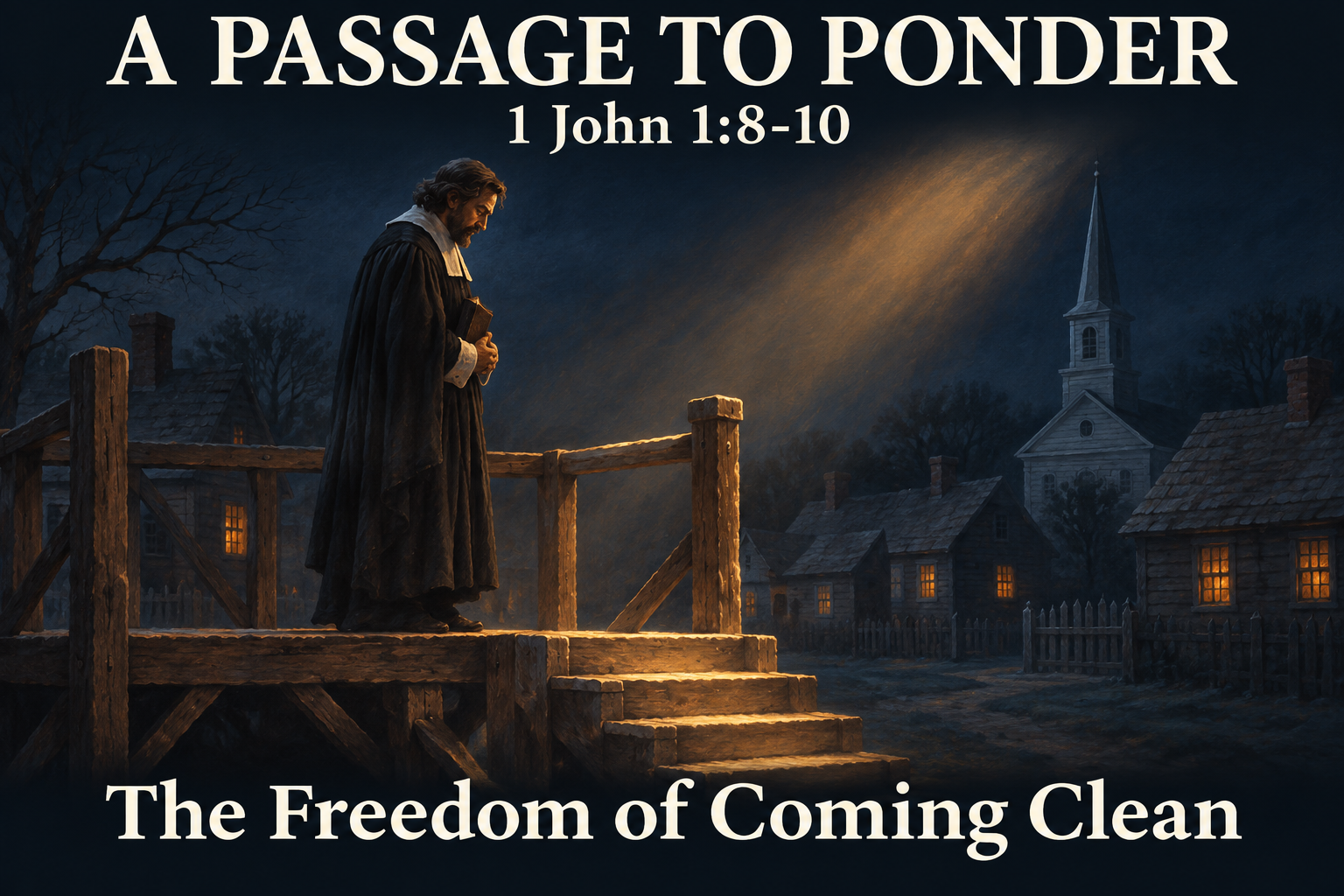
In Nathaniel Hawthorne’s classic novel The Scarlet Letter, Hester Prynne bears the public shame of her adultery. The scarlet “A” on her clothing announces her guilt to everyone.
But Arthur Dimmesdale, the minister who shares her sin, conceals his involvement. While Hester endures public disgrace, he continues to receive public admiration.
Yet his secret provides no peace. Guilt torments him. The man others regard as godly knows what he is hiding.
At one point, Dimmesdale stands on the scaffold where Hester suffered humiliation. But he comes at night. He occupies the place of confession while the town sleeps.
Finally, near the novel’s end, he publicly acknowledges his guilt. His carefully protected reputation can no longer substitute for honesty before God.
Hawthorne’s story raises a searching question: Are we more concerned with appearing righteous than being honest about our unrighteousness?
In 1 John 1:8–10, the apostle confronts our tendency to deny, excuse, or conceal our sins.
“If we say that we have no sin, we deceive ourselves, and the truth is not in us. If we confess our sins, He is faithful and just to forgive us our sins and to cleanse us from all unrighteousness. If we say that we have not sinned, we make Him a liar, and His word is not in us.” (NKJV)
John’s message, however, offers hope. We can acknowledge what God already knows and receive the forgiveness He promises.
This text reminds us of four simple but important truths.
#1 Face the truth about ourselves
We all have sinned.
Every accountable human being on earth has committed sin. Indeed, “There is none righteous, no, not one” (Rom. 3:10). Sin is the common challenge of humankind, regardless of race, economic condition, social status, or religious affiliation.
Remember, John is writing to Christians. He includes himself when he says, “If we say that we have no sin.” Christians are not immune to sin.
#2 Denying sin deceives us
When we deny our sins, we deceive ourselves.
Our human tendency is to make excuses, shift blame, and refuse personal responsibility. God holds each of us accountable for our attitudes and actions, regardless of the circumstances surrounding our sins.
The Greek word for sin in this verse is hamartia. One way to picture sin is as missing the mark. W. E. Vine calls it “the most comprehensive term for moral obliquity.” It may refer to sins of commission or omission.
Who among us has not missed the mark in some way in obeying God’s Word? In speech? In actions? In attitude? Or by failing to do good when we have the opportunity?
#3 Confess our sins to God
When the excuses are exhausted, and we honestly examine ourselves, we will have to say, like King David, “I have sinned” (2 Sam. 12:13). It’s painful. Sometimes embarrassing. Definitely humbling. But it’s the only correct course of action.
Sometimes coming clean begins with a simple prayer. “Lord, I spoke harshly. I knew better. Please forgive me.”
Failure to confess our sins affects our relationship with God and with other people. It also leaves us struggling with guilt. Sin steals the joy of our salvation. Warren Wiersbe was right when he wrote, “Basically, sin is the cause of the unhappiness that overwhelms our world today. Sin promises joy, but it always produces sorrow. The pleasures of sin are temporary – they are only for a season (Heb. 11:25). God’s pleasures last eternally – they are forevermore (Ps. 16:11).”
God’s faithfulness and justice assure us of forgiveness and cleansing.
#4 Accept God’s verdict about sin
When we deny that we have sinned, we contradict what God has said about us. John puts it plainly. We make Him a liar. Our attitude ought to echo Paul’s words, “Let God be true and every man a liar” (Rom. 3:4).
We don’t have to hide in the shadows. Or cower in fear. Or put on a façade to protect our reputation. We can tell God the truth about our sins. He already knows. And He has promised to forgive and cleanse us.
That’s the freedom of coming clean.
–Ken Weliever, The Preacherman

