
There’s an old story about a young farmer down in the Bootheel of Missouri who’s plowing his field one spring. He’s growing discouraged with farming. He tried planting cotton, but it didn’t do very well. Soybeans weren’t any better.
He’s wondering what he ought to do with the rest of his life. As he steers his tractor up one row and down another, he utters a fervent prayer to God: “Lord, if you have a plan for my life, please send me a sign, and I will obey.”
Just then, the farmer looks up and sees the clouds in the sky rearranging themselves to form the letters “P.C.”
“Preach Christ,” exclaims the farmer. “Of course!”
Coincidentally, the little church where he attends is looking for a new preacher. So, he goes to the elders and says he feels called to preach and asks if they would consider him. Reluctantly, they agree to let him preach a sermon.
Well, he’s terrible. His lesson was ill-conceived. His Scriptures didn’t prove his points. And his delivery was long and boring. After the lesson, the elders met and tried to figure out a way to let him down easy without hurting his feelings.
However, the young man is adamant that the Lord called him to preach. Finally, they ask, “Why do you think the Lord is calling you?”
“Well, I tried planting cotton, then soybeans, and then rice. None of the crops was successful. Then I asked the Lord for a sign, and the clouds formed the letters PC—and I knew the Lord was saying to me ‘preach Christ.’”
One of the elders looked at him and said, “Son, I think you misread the call. The Lord was saying, ‘Plant Corn!’”
The farmer wasn’t the only one who misunderstood a calling. Many people today have the same confusion—not about farming, but about faith.
Unfortunately, many people in the religious world don’t really understand what it means to be called by God. They are looking for signs and signals in the wrong place and misinterpreting God’s call.
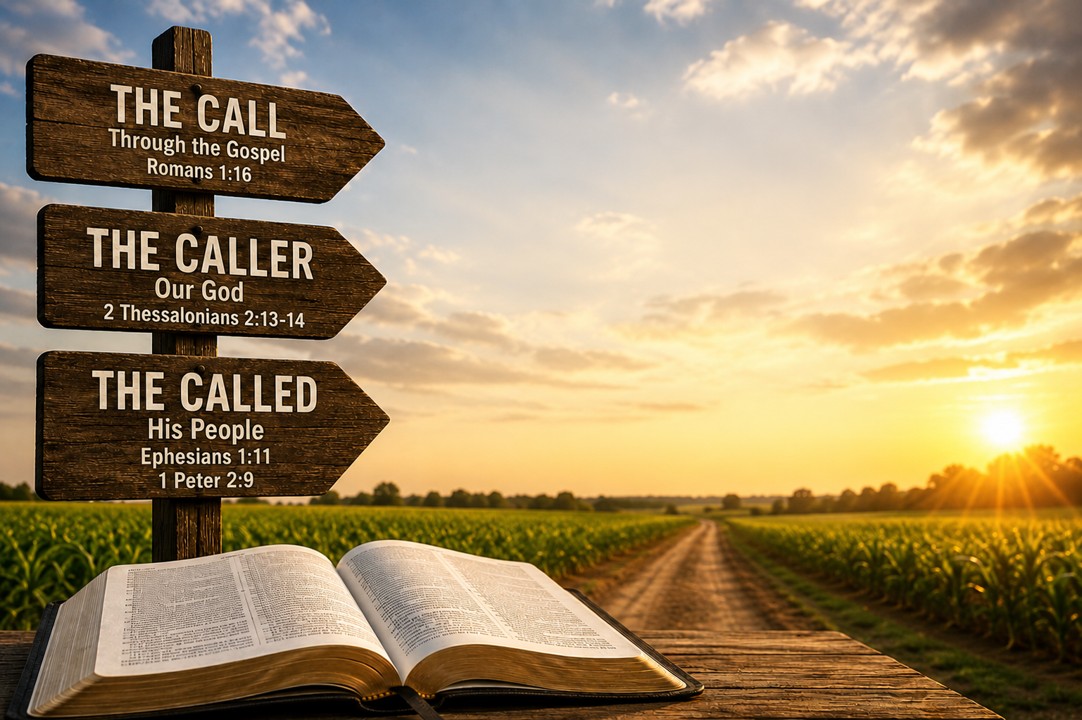
Consider these Bible answers to three questions about our calling.
(1) How does God call us?
We are called in the same way that the Thessalonian brethren were called.
“But we are bound to give thanks to God always for you, brethren beloved by the Lord, because God from the beginning chose you for salvation through sanctification by the Spirit and belief in the truth, to which He called you by our gospel, for the obtaining of the glory of our Lord Jesus Christ.” (2 Thess. 2:13-14)
Today, God does not call us to salvation through cloud formations, visions, dreams, or mystical experiences. He calls us through the gospel, God’s power unto salvation (Rom. 1:16).
The call of God is not hidden. It is not mysterious. It has been revealed through His Word.
(2) What kind of calling is it?
The Bible says our calling is a “holy calling according to His own purpose and grace…” (2 Tim. 1:8-9).
Our calling is not physical. It is not a vocational calling. It is not a secular calling. It is a sanctified, spiritual calling.
God’s call is not primarily about what career we pursue, where we live, or what earthly accomplishments we achieve. It is about who we are becoming in Christ.
(3) Why does God call us?
According to the previous passage, our calling is in accordance with God’s purpose. Purpose has to do with the reason for which something exists.
Our purpose in the Lord is to glorify, honor, and praise Him (Eph. 1:11). It is a predestined purpose (Eph. 1:11) and an eternal purpose (Eph. 3:10-11).
We are called to be members of His holy family (Eph. 1:19; 1 Pet. 2:5, 9). We are called to be a magnifier of our holy God (John 4:23-24). We are called to model the character of our holy mentor, Jesus Christ (1 Pet. 2:21). We are called to be ministers of a holy ministry (1 Pet. 4:10). And we are called to be messengers of a holy message (2 Cor. 5:18-20).
God’s call is not mysterious. It is clear.
We are called to belong to His family. Worship His name. Serve His purpose. Grow in His likeness. And share His message.
I remember an old song from my childhood, “Jesus is calling.”
Indeed, He is.
He is calling us through His Word. It is a holy calling. And the purpose of our calling is to obey Him.
—Ken Weliever, The Preacherman


Pingback: Weekly Recap: June 8-12 | ThePreachersWord