
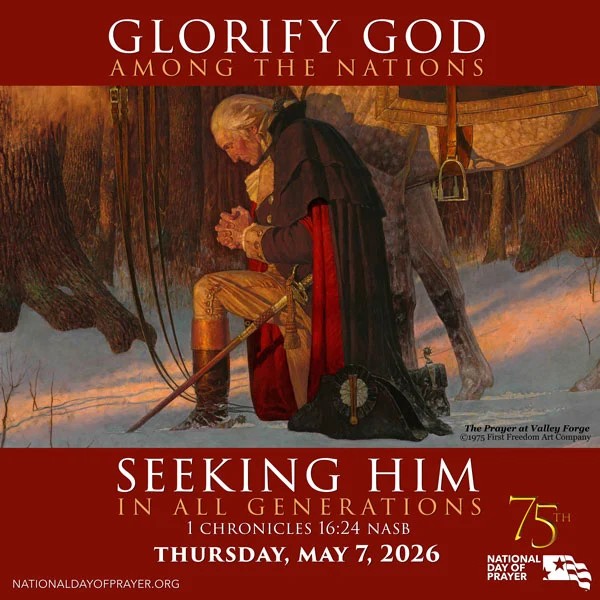
Today, as designated by the United States Congress, we observe the National Day of Prayer, held each year on the first Thursday in May.
Established in 1952 and later set by President Ronald Reagan, this day serves as a call for Americans to seek God in prayer.
This year’s theme is “Glorify God Among the Nations: Seeking Him in All Generations,” based on 1 Chronicles 16:24, which records King David’s prayer of thanksgiving when the Ark of the Covenant was returned to Jerusalem:
Tell of His glory among the nations,
His wonderful deeds among all the peoples.
According to its official website, the National Day of Prayer exists “to mobilize unified public prayer for America.” Its president challenges believers to embrace this theme and commit to prayer not just today, but throughout the next 365 days.
Calls to national prayer have deep roots in American history. Even before our nation was formed, the Continental Congress in 1775 urged the observance of “a day of public humiliation, fasting, and prayer.” Our first President, George Washington, proclaimed a day of public thanksgiving and prayer. Later, in the midst of the Civil War, President Abraham Lincoln called for a national day of fasting and prayer in 1863.
Yesterday, a proclamation on the White House website recognized the National Day of Prayer, stating:
“This National Day of Prayer, we honor America’s enduring tradition of prayer, faith, and trust in Almighty God. And as we celebrate 250 glorious years of American independence, we pledge to never forget the countless blessings God has bestowed upon our people and our country.”
While Christians may differ on political issues, policies, or even the role of prayer in public life, Scripture leaves no doubt about one responsibility: we are to pray for our leaders.
The apostle Paul instructed first-century Christians to pray for governing authorities:
“Therefore I exhort first of all that supplications, prayers, intercessions, and giving of thanks be made for all men, for kings and all who are in authority, that we may lead a quiet and peaceable life in all godliness and reverence” (1 Tim. 2:1–2).
The English theologian Robert Hall once observed, “There is nothing which so tends to allay irritation, to excite compassion, to restrain envy and revenge, to calm the turbulent passions of every kind, as fervent prayer.”
- Suppose we prayed for our President instead of picking apart his policies.
- Suppose we prayed for Congress instead of criticizing every decision.
- Suppose we interceded for elected officials instead of condemning them on social media.
- Suppose we gave thanks for our blessings instead of complaining about our burdens.
- Suppose God’s people were united in prayer instead of divided by partisan politics.
We would likely discover that prayer not only changes circumstances, but it changes us. As Søren Kierkegaard wrote, “Prayer does not change God, but it changes him who prays.”
For the Christian, every day ought to be a day of prayer, as Paul exhorted: “Pray without ceasing” (1 Thess. 5:17).
As we approach our nation’s 250th anniversary, there are legitimate concerns about its direction, its moral compass, and many of its leaders. Yet we do not have to curse the darkness—we can light a candle.
We can…
- Pray (Lk. 18:1).
- Do good (1 Pet. 3:11).
- Glorify Him (1 Pet. 2:12).
- Tell of His greatness (Ps. 71:19).
- Love our neighbor (Matt. 22:39).
- Live the Golden Rule (Matt. 7:12).
- Share our faith (1 Pet. 3:15).
- Be the light (Matt. 5:14–16).
- Speak evil of no one (Titus 3:2).
- Let our gentleness be known to all (Phil. 4:5).
- And continue steadfastly in prayer (1 Thess. 5:17).
So, let us pray–for peace, unity, reconciliation, our nation, our leaders, the lost, the success of the Gospel, and God’s continued blessings.
But be advised: that which is prefaced by prayer must be punctuated by practice.
—Ken Weliever, The Preacherman


Pingback: Weekly Recap: May 4-8 | ThePreachersWord