
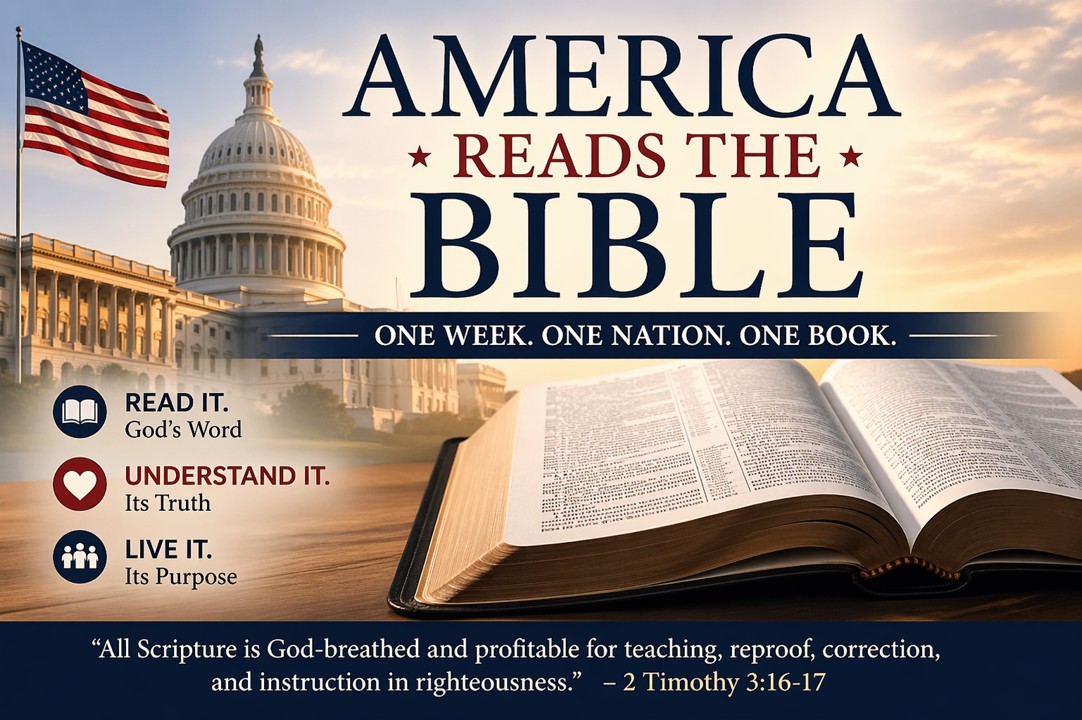
For one week, the Bible is being read aloud in the nation’s capital—publicly, continuously, and by voices from every corner of American life.
“One Week. One Nation. One Book” is the theme of “America Reads the Bible.”
The weeklong event in Washington, D.C., features daily Scripture readings from morning to evening, with nearly 500 participants—including political leaders, media personalities, and representatives of various ministries.
The event is modeled after Ezra’s public reading of Scripture in the Old Testament, according to Bunni Pounds, founder and president of Christians Engaged, which is sponsoring the initiative.
The United States has a long history of respect for the Bible. From George Washington to Abraham Lincoln, American leaders have often expressed deep appreciation for its message and moral guidance. Washington observed that it is impossible to rightly govern without God and the Bible. Lincoln affirmed his belief in Scripture as God’s Word, noting that it speaks to the human condition and reveals the Savior to the world.
This week’s endeavor prompts three simple thoughts.
#1 Any enterprise that promotes Bible reading is good.
Reading Scripture has been emphasized in every age where God’s Word has been recorded. In the Old Testament, Moses commanded parents to teach their children God’s Word:
“You shall bind them as a sign on your hand, and they shall be as frontlets between your eyes. You shall write them on the doorposts of your house and on your gates” (Deut. 6:8–9).
God’s Word was to guide their thoughts, shape their hearts, and influence their homes and daily lives.
Ironically, the Jews later took this command quite literally, creating small boxes—phylacteries—that they wore on their hands and foreheads with verses inside. What began as a symbol eventually became an ostentatious display, which Jesus condemned (Matt. 23:5).
During the return from captivity, Ezra the scribe read God’s Word publicly to the people. But he did more than read—he explained it so the people could understand its meaning (Neh. 8:1–7).
Public reading is good. But Scripture was never meant to be merely heard—it must be understood, absorbed, and lived.
#2 Bible reading should not be politicized.
Whenever Scripture is brought into the public square, questions of motive are never far behind. That’s not new.
Some have suggested that this event carries political overtones. I hope that is not the case. God’s Word is for everyone. It was preached in the first century to Jews and Gentiles, bondservants and masters, males and females. It spread from Jerusalem to Judea, Samaria, and throughout the Roman Empire.
As Paul wrote, all Scripture is God-breathed and profitable for teaching, reproof, correction, and instruction in righteousness—equipping us for every good work (2 Tim. 3:16–17).
Even when motives are mixed, we can still rejoice that the Word is being proclaimed, just as Paul did when Christ was preached from less-than-pure intentions (Phil. 1:15–18).
#3 More important than reading the Bible is applying it.
Reflecting on those who read the Bible—whether leaders, public figures, or everyday people—I’m reminded of a story told by Mark Twain.
A businessman, known for his ruthless dealings, once said to Twain, “Before I die, I intend to make a pilgrimage to the Holy Land. I will climb Mount Sinai and read the Ten Commandments aloud at the top.”
Twain replied, “I have a better idea. You could stay in Boston and keep them.”
That’s the difference between reverence and obedience.
Reading the Word is good. Obeying it is better.
With representatives from more than 100 ministries participating this week, perhaps the better question is not, “Are we reading the Bible?” but “Are we obeying its commandments?”
The theologian J. I. Packer described Scripture as “God preaching.” May we listen to His voice as they did in Ezra’s day—and respond with a sincere “Amen.”
—Ken Weliever, The Preacherman


Pingback: Weekly Recap: April 20-24 | ThePreachersWord