
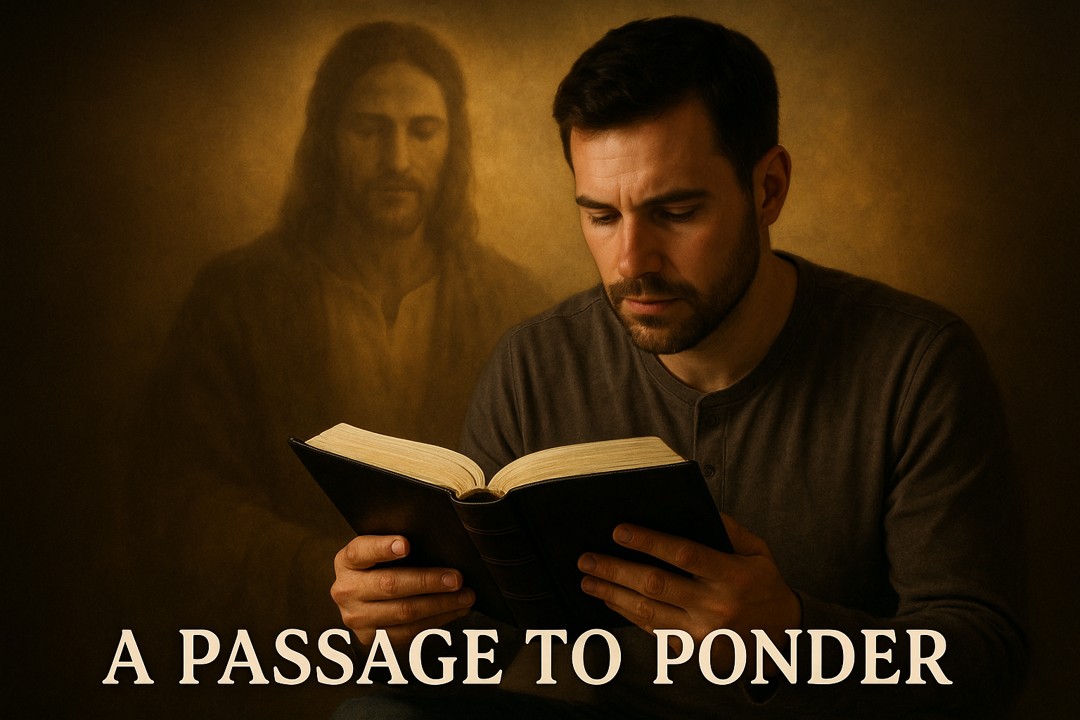
Imagine a man commuting to work on the train every morning.
He sits in the same seat, often surrounded by the same group of people. He never preaches a sermon or hands out Bible tracts, but over time, his fellow passengers notice something about him. He’s patient when the train is delayed, kind to the conductor, and quick to give up his seat to someone who needs it.
One day, when a crisis happens on the train, people instinctively turn to him for calm and reassurance—because they’ve been “reading” his life every day without realizing it.
He may never have spoken a word about his faith on that train, but his consistent character was like an open letter, silently communicating Christ’s love, peace, and compassion. Later, when one of his fellow passengers faces a personal struggle, they approach him—not because of a pamphlet or a speech, but because they’ve already read his “epistle” in the way he lives.
Our passage today from Paul’s pen speaks to that ideal of Christian living.
“You are our epistle written in our hearts, known and read by all men; clearly you are an epistle of Christ, ministered by us, written not with ink but by the Spirit of the living God, not on tablets of stone but on tablets of flesh, that is, of the heart.”
One writer offers this insight on Paul’s proclamation.
Paul’s imagery is both profound and practical. He likens the Corinthians to a letter of Christ. A letter communicates a message from the sender to the recipient. In this case, Christ is the author, Paul and his co-workers are the scribes, and the ink is the Spirit of God. The message is not preserved on fragile parchment or cold stone, but inscribed on the warm, receptive tablets of human hearts. This shows that Christianity is not merely about external laws or rituals but about the inward transformation of character by the Spirit.
The analogy spoke to Paul’s Jewish audience. The “tablets of stone,” which allude to the Ten Commandments written on stone, represent the Old Law. In contrast, the New Covenant of Christ penetrates the heart and engraves its truth on the inner person, shaping our lives to be conformed to the image of Christ. As Charles Spurgeon once said, “A Christian should be a striking likeness of Jesus Christ. You are to be pictures of Christ to others.”
Our lives are an open book for others to see and read. And it is always open, whether we realize it or not. D. L. Moody once remarked, “Of one hundred men, one will read the Bible; the ninety-nine will read the Christian.” Our influence brings the truth of the gospel to life and serves as an unmistakable testimony for the Lord.
Several years ago, when I was preaching in Tampa, we had a large number of college students. Many attended Florida College, and several transferred to the University of South Florida. It was interesting to see the influence of these Christians on the USF campus as they touched the lives of their friends. One young lady asked one of our students, “Where do you go to church?” She was surprised because they had never talked about it. She asked, “How do you know I go to church?” The inquiring seeker said, “Because you’re different. You’re not like the other students on campus.” She had noticed her dress, choices of entertainment, speech, and godly attitude.
Of course, the opposite can be true. When we live contrary to Christ’s teaching, talk ugly, treat others disrespectfully, and generally live like the world, people see it. No amount of words can overcome an unrighteous attitude. Augustine is credited with saying, “What you are speaks so loudly, I cannot hear what you say.” Our behavior either confirms and corroborates the faith we profess or contradicts and discredits it.
The words of the poet Annie Johnson Flint challenge us all with this sobering message.
We are the only Bible
The careless world will read;
We are the sinner’s Gospel,
We are the scoffer’s creed;
We are the Lord’s last message,
Given in deed and word;
What if the type is crooked?
What if the print is blurred?
–Ken Weliever, The Preacherman
 ThePreachersWord
Pingback: Weekly Recap: | ThePreachersWord