
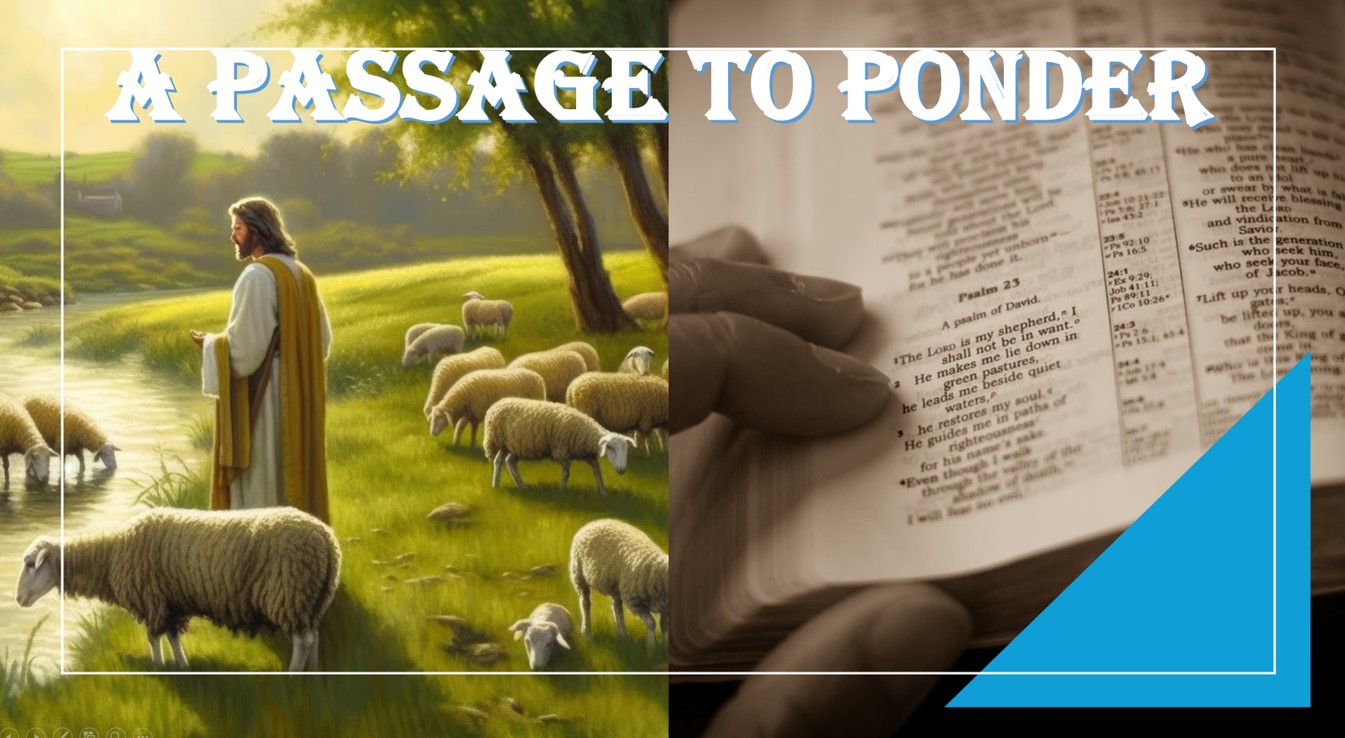
In his book, God’s Psychiatry, Charles L. Allen tells about a businessman who came to him for advice.
The businessman was talented, successful, and had risen to be chosen as president of his company. “Yet, along the way,” Allen wrote, “he had left out something, and one of the things he did not achieve is happiness.” Allen observed that he was a nervous, tense, worried, and a sick man.
Prescription medicine from his family doctor didn’t help. So on the recommendation of his physician, he came to Charles Allen, a minister, whose prescription was simple. Read Psalm 23 five times a day for seven days.
He was instructed him to read it when he first awoke. Then after breakfast. Also after lunch and supper. And before bed time. Each time he was he read it carefully. Meditatively. And prayerfully.
“The twenty-third Psalm is one of the most powerful pieces of writing in existence,”opined Allen, “it can do marvelous things for any person.”
Apparently, many people agree with that assessment. According to Gateway.com the most read Bible passages from their webpage were from the Psalms with verses from Psalm 23 claiming the top six spots, and Psalm 23 being the most read chapter.
Today, we begin a 12 lessons series, with installments each Wednesday, considering this beautiful and beloved Psalm.
“The Lord is my Shepherd,” begins David known as the Shepherd King of Israel. He was intimately familiar with tending sheep as a lad before he became famous as a giant killer, and latter the successor to Saul as the second King of Israel.
The statement is simple but filled with a calm assurance that recognized Jehovah God as the One who protected, fed, led, and sustained him. But not just a Shepherd, or the Shepherd, but “My Shepherd.” It’s a statement of faith and trust in the Lord.
“The Lord is my Shepherd” sounds sweet and serene, but in a sense it’s not a great compliment to those of us who are identified as the sheep. Sheep, I am told, are some of the dumbest and dirtiest animals that require more tending than any other livestock.
Sheep require great attention, since they are unable to care for themselves. They are defenseless and easily preyed upon by wild predators. Sheep are timid and helpless. They often get lost. And literally don’t know how to come in out of the rain.
So, when Isaiah said, All we like sheep have gone astray; We have turned, every one, to his own way” (Isa 53:6) it speaks to a familiar metaphor that implies our need for a shepherd to guide, guard, and care for us. Jesus pronounced Himself as “the good Shepherd” who will care for us. Protect us. And supply all that we require (John 10:7-16).
Our Shepherd knows our every need and is more than willing to provide for us. He is there when we need him. He will chase the wolf away. And even lay down his life for us, which He did when He died on the cross.
It’s no accident that the Bible uses the Shepherd metaphor to refer to elders in the church who are also called pastors (Eph. 4:11). Their role and responsibility is to shepherd the flock under the guidance and mandate of The Good Shepherd. In this regard the apostle Paul offered this counsel to the Ephesian Elders.
“Therefore take heed to yourselves and to all the flock, among which the Holy Spirit has made you overseers, to shepherd the church of God which He purchased with His own blood” (Ax. 20:28
John Maxwell is found of saying that in every organization “everything rises and falls on leadership.” The elders in local congregations would do well to pattern their leadership after the model in Psalm 23. They, along with all the rest of us, need to rely the Lord and echo this truth–”The Lord is my Shepherd.”
Who are you following? Whose guidance do you rely on? Where do you find peace, protection, provisions, and providential care? Is the Lord your Shepherd?
–Ken Weliever, The Preacherman
 ThePreachersWord
In Psalm 23, paying attention to the pronouns “You and I” and how they are used in English, I envision the Shepherd and the Lamb demonstrating their interdependent relationship. The Shepherd relies on the lamb’s body to supply the milk, the meat and the oil for the Shepherd’s table…and the Shepherd in turn gives the rod and staff to the Lamb for protection. The Shepherd doesn’t use it to have dominion over the Lamb. Thus with this song, the Shepherd and the Lamb lead their followers demonstrating the need to protect each other from death and to take delight and rejoice in the other with mutual respect–singing “I will dwell in the house of the Lord forever.” (Vogt Turner, originally published in Ecological Theology an Environmental Ethics Vol.3).
LikeLike
Pingback: Weekly Recap: January 6-10 | ThePreachersWord
Pingback: Psalm 23: “I Shall Not Want” | ThePreachersWord