
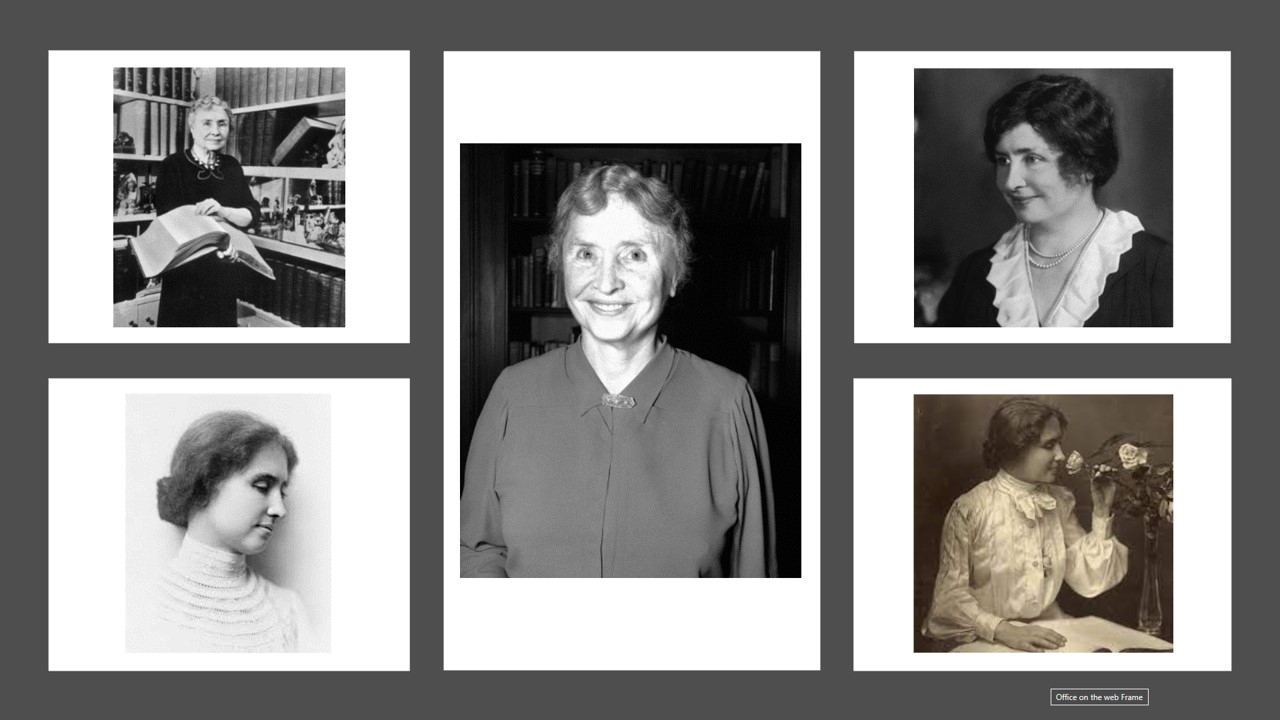
It was on this day 55 years ago, June 1, 1968, that American icon, author and lecturer, Helen Keller died.
Keller’s story was one we learned in school as a inspiring example of courage, persistence and victory over adversity.
Born on June 27, 1880, Helen was stricken with a disease when she was 19 months old that left her both blind and deaf. In those days special education for such children was in its infancy. However, prior to her 7th birthday, a special ed teacher, Anne Sullivan, was summoned to teach Helen.
It’s said that “under Sullivan’s dedicated guidance, Keller learned at a staggering rate.” She was able to receive a formal education at Wright-Humason School for the Deaf and later the Cambridge School for Young Ladies in Massachusetts. After High School, Helen was accepted into Radcliffe and graduated cum laude.
From her writing and lectures, three quotes stand out that teach great lessons.
#1 The value of a vision.
Once asked about her handicap, Helen replied, “The only thing worse than being blind is having sight but no vision.
Vision is invaluable to achieve goals in life. To be successful in any endeavor one must see the end from the beginning. This is true in business, industry, sports, and most importantly, in spiritual matters. Vision moves the church forward to achieve God’s purpose and mission.
The Christian vision, of course, lies beyond this life. It’s greater than a material goal or a physical accomplishment. Vision allows us to deal with the difficulties in life. The apostle Paul offers this wonderful insight in 2 Corinthians 4:16-18.
“Therefore we do not lose heart. Even though our outward man is perishing, yet the inward man is being renewed day by day. For our light affliction, which is but for a moment, is working for us a far more exceeding and eternal weight of glory, while we do not look at the things which are seen, but at the things which are not seen. For the things which are seen are temporary, but the things which are not seen are eternal.”
Sadly, too many only see the physical and the temporal and are blinded to the spiritual and the eternal.
#2 Life is about serving others.
Helen Keller could have thrown herself a pity party and made life all about her problems, difficulties and handicaps. However, she once wrote, “Life is an exciting business, and most exciting when it is lived for others.”
In his letter to the Philippian brethren, Paul reminded them and us that the Christian life is about serving the needs of others.
“Let nothing be done through selfish ambition or conceit, but in lowliness of mind let each esteem others better than himself. Let each of you look out not only for his own interests, but also for the interests of others” (Phil. 2:3-4).
This command encapsulates the golden rule and the 2nd great commandment. It’s about being others focused. Treating people with dignity and respect. Demonstrating the love of God. And exhibiting Christ-like humility in sacrifice service in our attitudes and actions.
In fact, this principle expressed in the Rotary slogans, “He Profits Most who Serves Best,” and “Service Above Self, were first taught and modeled by Jesus (Matt. 20:24-28).
#3 Learn to be content with your lot in life.
Helen Keller said, “My life has been happy because I have had wonderful friends and plenty of interesting work to do.” Later she wrote, “I seldom think about my limitations, and they never make me sad. Perhaps there is just a touch of yearning at times, but it is vague, like a breeze among flowers. The wind passes, and the flowers are content.”
It’s so easy to become jealous or envious of someone who has attained more, or who has accomplished more than we have. Yet, even when we find ourselves with some disadvantages, or perceived handicaps, it’s possible to look on the bright side. To appreciate our blessings. To turn our problems into possibilities. Our obstacles into opportunities. And our trials into triumph.
Once again, the apostle offers this wonderful insight into Christian contentment.
“I speak in regard to need, for I have learned in whatever state I am, to be content: I know how to be abased, and I know how to abound. Everywhere and in all things I have learned both to be full and to be hungry, both to abound and to suffer need. I can do all things through Christ who strengthens me” (Phil. 4:11-13).
Paul said he had “learned…to be content.” Contentment is not necessarily natural, it’s something we must learn.
Vision. Service. Contentment. Three great qualities that will improve our lives and those we touch.
Finally, this piece of advice from Helen Keller: “Optimism is the faith that leads to achievement; nothing can be done without hope.”
–Ken Weliever, The Preacherman
 ThePreachersWord
Excellent…. I heard about her way, way back when. 😉 Keep ’em coming, brother. wwp
LikeLike
Pingback: Weekly Recap: May 29-June 2 | ThePreachersWord