
If you could travel to the International Space Station and spend six months in space, what two personal items would you take—and why?
In November 2020, astronaut Victor Glover launched on a 186-day mission as pilot of a SpaceX crew. Open about his faith, Glover shared that he took his Bible and disposable communion cups with him.
During that time, he worshiped virtually every Lord’s Day, spending time in prayer, Bible reading, and reflecting on the glory of God’s creation—all the while, 250 miles above the earth.
Yesterday, Glover was part of the successful launch of Artemis 2 and will pilot the 10-day mission around the moon along with three other astronauts. Upon being selected for this mission, Glover humbly responded, “I want to thank God for this amazing opportunity.”
He also added, “I pray that God will bless this mission. But I also pray that we can continue to serve as a source of inspiration for cooperation and peace—not just between nations, but in our own nation.”
When not in space, Glover has worshiped with the League City church of Christ and the Southeast church of Christ in the Houston area.
While it is often asserted that atheists and skeptics are the educated and scientifically informed, and therefore not believers in God or the Bible, Glover openly challenges that stereotype. In fact, many scientists are people of faith.
Victor Glover’s résumé is impressive—an engineering degree from California Polytechnic State University, three master’s degrees, advanced study at Air University and the Naval Postgraduate School, and service as a U.S. Navy captain flying F/A-18 combat missions in Iraq.
Yet, with all of his education and experience, he remains a man of deep and visible faith.
Over the years, Captain Glover has been interviewed by The Christian Chronicle and other faith-based outlets. He has often observed that there is no conflict between the Bible and science, including the Genesis account of creation and what we know about our universe. As he simply puts it, “I believe in both faith and science, and I don’t find them to be in conflict.”
As he gazes upon the earth from space, Glover is reminded of the truth expressed by the psalmist in Psalm 19:
The heavens declare the glory of God,
and the sky above proclaims his handiwork.Day to day pours out speech,
and night to night reveals knowledge.There is no speech, nor are there words,
whose voice is not heard.Their measuring line goes out through all the earth,
and their words to the end of the world.
Having accumulated over 3,500 flight hours in more than 40 aircraft—and landing on aircraft carriers over 400 times—Glover offers this personal insight:
“My career is fed by my faith, and, you know, anytime I do something pretty risky, I pray—before I fly, every time I fly.”
Glover’s faith is well known within the NASA community. “We talk about our solar system,” he says, “and I will often refer to the beauty of creation. People hear that, and it’s like a trigger word for certain folks.” Still, he is not shy about his profession of faith in Christ.
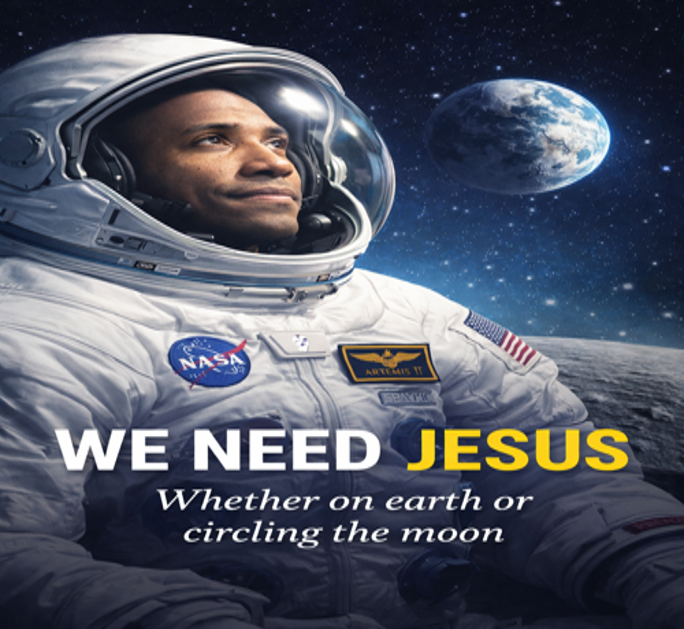
As a committed Christian, Glover has emphasized his dependence on Jesus, stating, “We need Jesus—whether on earth or circling the moon.” He describes himself as a “sinner in need of Jesus” and views Him as the bridge that spans our sin.
Glover has also requested the prayers of his brethren for safety and success for the Artemis II mission.
He is fond of saying, “In the military, there’s a saying that there are no atheists in foxholes. There aren’t any on top of rockets, either.”
Faith that reaches from earth to orbit…and from orbit to the moon…is a Faith worth believing and embracing.
Glover’s example reminds us that faith is not confined to church buildings or quiet moments—it travels with us into every arena of life. Whether we are on the ground or reaching for the stars, our dependence on God remains the same.
—Ken Weliever, The Preacherman
 ThePreachersWord