
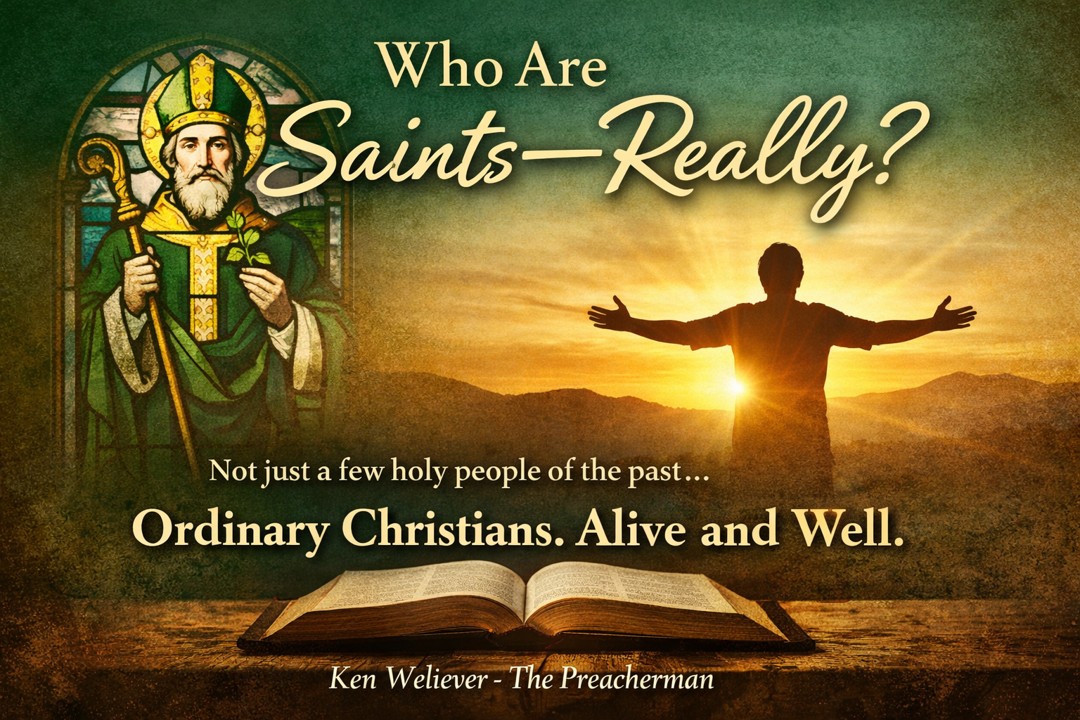
Today is St. Patrick’s Day—a day when millions celebrate a “saint.”
But here’s a question worth asking: Who are saints, really?
It was on this day that Patrick, a Catholic bishop, died in Saul, Downpatrick, Ireland.
While the day began as a religious observance honoring Patrick’s missionary work, it has evolved into a broader celebration of Irish culture—complete with green attire, parades, and traditional foods.
The story of Patrick is certainly interesting. Though closely associated with Ireland, he was actually born in what is now Wales. At age 16, he was captured by Irish raiders and enslaved for several years. After escaping, he returned home to Britain and was reunited with his family.
Later, after studying for the priesthood and being ordained as a bishop, Patrick returned to Ireland as a missionary. Over time, many legends grew around him, elevating him to a larger-than-life figure.
He came to be known as the patron saint of Ireland—though interestingly, the formal process of canonizing saints did not begin until centuries later. Historical sources note that in 993 A.D., Pope John XV officially canonized Ulrich of Augsburg, marking the first recorded papal canonization.
According to Catholic teaching, sainthood is officially recognized after death through a lengthy process affirming that a person lived a life of exceptional holiness. Such individuals are believed to be in heavenly glory and may be invoked in prayer.
I couldn’t help but smile when I read that—because in the New Testament, saints weren’t a select few honored after death. They were ordinary Christians…alive and well.
In his letters to the churches at Rome, Corinth, Ephesus, Colosse, and Philippi, the apostle Paul addressed believers as saints (Rom. 1:7; 1 Cor. 1:2; Eph. 1:1; Col. 1:2; Phil. 1:1). There was no special ceremony, no canonization process, and no distinction reserved for a spiritual elite.
Nor do we find first-century Christians praying to saints or through saints. Prayer is directed to God (Heb. 4:16) through the one mediator, Jesus Christ (1 Tim. 2:5).
So, what does the Bible teach about saints?
(1) Saints Belong to God
Paul wrote to the Corinthians, “To the church of God which is at Corinth, to those who are sanctified in Christ Jesus, called to be saints…”
Believers are called through the gospel. We belong to God and are part of His eternal purpose. He has prepared an inheritance for His people.
In the Old Testament, the word holy referred to that which was set apart for God. The tabernacle was holy—different from other buildings. The Sabbath was holy—set apart from other days. Israel was holy—distinct from other nations.
In the same way, Christians are holy. As saints, we are set apart. We belong to God and enjoy fellowship with the One we call “Our Father.”
(2) Saints Belong to One Another
The Christian life is not lived in isolation. We are part of a spiritual family.
Paul reminds us that we are “fellow citizens with the saints,” calls us to express “love for all the saints,” to engage in “equipping the saints for the work of ministry,” and to “keep on praying for all the saints” (Eph. 2:19; 1:15; 4:12; 6:18).
As we grow closer to God, we naturally grow closer to one another. Our fellowship deepens. Our care increases. Our unity strengthens.
(3) Saints Stand Apart from the World
While we live in the world, we are not to be shaped by it.
Christians are called to rise above the world’s carnality, sensuality, and secularism. We are to develop a different mindset, a different moral compass, a different perspective, and a different motivation (Rom. 12:1–2; 1 Thess. 4:3–8; Col. 3:1–2; 1 Pet. 1:13–16).
We don’t think like the world.
We don’t live like the world.
And we don’t define success the way the world does.
None of this is meant to discourage anyone from enjoying St. Patrick’s Day—wearing green, sporting a shamrock, or enjoying traditional foods.
But it is a reminder of something far more important:
All Christians are saints.
Don’t be like the woman who once said, “I’m not a saint—but I’m no sinner either.” In reality, we are one or the other.
And by God’s grace, you’re not just called to admire saints—you’re called to be one.
—Ken Weliever, The Preacherman
(Note: After writing this post, I asked ChatGPT for suggestions to improve it. In addition to offering a few ideas to tighten the structure, it agreed with the content and said, “excellent Biblical grounding.” Hmm, apparently, AI knows something that a lot of folks don’t know.
 ThePreachersWord
Pingback: Weekly Recap: March 16-20 | ThePreachersWord