
I haven’t counted them, but Bible commentator Warren Wiersbe notes that the Jews identified 613 commandments in the Old Law—248 positive and 365 negative.
Supposedly, they had also divided the commandments into two basic categories: “heavy” or important commandments and “light” or unimportant commandments. Thus, one could focus on the “heavy commandments” and not worry as much about the “light” ones.
So, among the religious leaders, there was an ongoing debate: “What is the greatest commandment in the Law?”
In Matthew 22, this is the question put to Jesus in an effort to trap or test Him. Jesus’ response, however, cut to the very heart of the issue.
37 Jesus said to him, “You shall love the Lord your God with all your heart, with all your soul, and with all your mind.”
38 This is the first and great commandment.
39 And the second is like it: “You shall love your neighbor as yourself.”
40 On these two commandments hang all the Law and the Prophets.”
This is a passage many of us have heard all our lives. We’ve read it, studied it, and listened to preachers explain it. But have we really applied it to our lives on a personal basis? In our spiritual walk? In our relationships? In our homes, our churches, and our neighborhoods? And with those who are hurting, as did the Good Samaritan in Jesus’ classic parable recorded in Luke 10?
As noted in previous posts on our theme Love More, Give More, the word “love” in our English language has been diluted in its usage as we speak of loving our homes, cars, clothes, kids, and chocolate pie. It’s well documented that the Greeks had four words translated “love,” three of which are found in Scripture.
Here, the word “love” comes from the Greek word agapao, which speaks of a love of the will—an unconditional love. “It means that to God we must give a total love,” writes William Barclay, “a love which dominates our emotions, a love which directs our thoughts, and a love which is the dynamic of our actions. All religion starts with love, which is a total commitment of life to God.”
The essence of God Himself is love (1 John 4:7–10). The Bible is a story of love—God’s love for humankind. A love epitomized in sending His Son on a rescue mission from heaven to earth to redeem fallen mankind. A love that still loves even when it is unrequited.
Thus, we were made to love—to love Him and to love those made in His image.
To love God with all of our hearts involves the entirety of our being. The heart is not the physical organ but the seat of our emotions—our passions, affections, desires, and purposes.
To love God with all our souls refers to our unique and distinct identity. It is the essence of our spirit, the very breath of our being.
To love God with all of our mind means to seek a thorough understanding of who He is, what He desires, and how we may please Him. This calls for thoughtful reflection and careful reasoning as we use our intellect to know Him and His will for our lives.
This love, however, cannot stop with our Creator; it must express itself in love for others—for the welfare of our fellow man. If we claim to love God, yet fail in our love for others, we deceive ourselves. The beloved John expressed it in these pointed words:
“If someone says, ‘I love God,’ and hates his brother, he is a liar; for he who does not love his brother whom he has seen, how can he love God whom he has not seen? And this commandment we have from Him: that he who loves God must love his brother also. “(1 John 4:20–21)
There is no magic formula for loving God and others. It must come from a heart that humbly acknowledges God’s presence, power, and provision. Thanksgiving leads to thanks-living.
It begins as we dig into His Word to truly know Him. It grows through prayerful communion and communication with Him.
When we realize how much He loves us and how richly we are blessed, we begin to look at others through a different lens. We see them as fellow creatures with souls created in God’s image, and we seek their welfare as sincerely as we would seek our own.
To begin this journey and find true fulfillment in following the two great commandments, we must “Draw near to God, and He will draw near to you” (James 4:8).
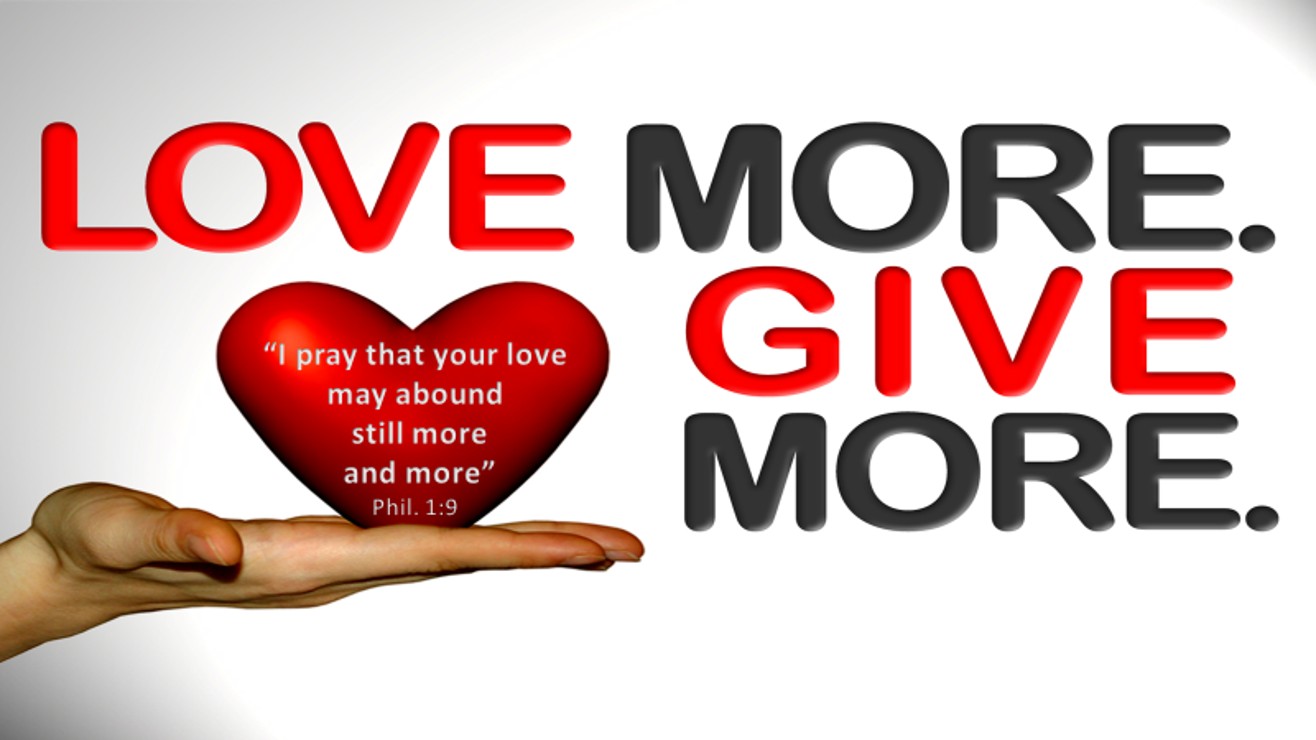
Indeed, He calls us to Love More, Give More.
—Ken Weliever, The Preacherman
 ThePreachersWord
Pingback: Weekly Recap: March 9-13 | ThePreachersWord