
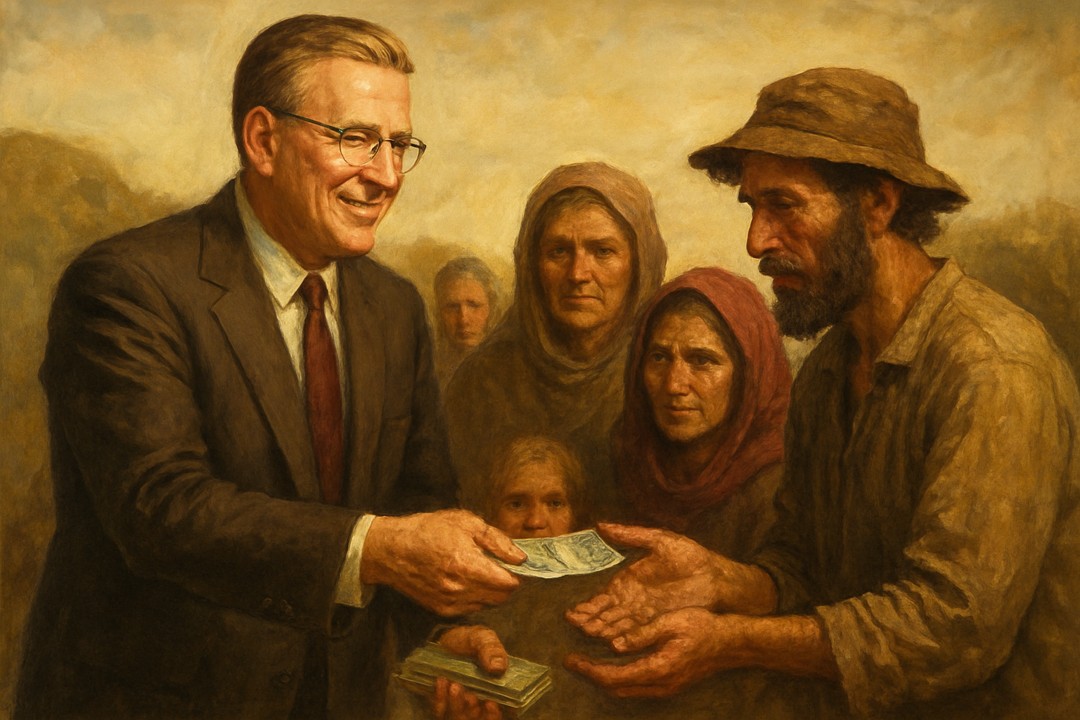
R. G. LeTourneau was one of the most inventive and successful businessmen in America in the early 1900s
Known as the “Father of the Modern Earthmoving Industry,” LeTrourneau pioneered machinery that transformed construction, mining, and ultimately even the Allied efforts in World War II. His innovations made him a multi-millionaire.
But it wasn’t his wealth that made his life remarkable—it was what he did with it.
Early in his business journey, LeTourneau and his wife, Evelyn, made a daring commitment: instead of giving God the traditional tithe, they reversed the percentages. They decided to live on 10% of their income and give away 90%. People were stunned. But LeTourneau simply said, “I shovel money out, and God shovels it back—but God has a bigger shovel.”
His generosity funded missionary work, Christian colleges, global relief efforts, and ministries that outlived him by decades. He didn’t view wealth as something to hoard but as something to harness for God’s purposes. And the more he gave, the more opportunities he discovered to bless others.
LeTourneau obviously understood both the danger and the potential for wealth.
Often, preachers, pastors, and concerned Christians focus more on the danger of wealth than on the potential for good. While we ought to warn that “love of money is the root of all kinds of evil,” greed is a sin, and money ought not to be our god, we must remember that God never condemned becoming wealthy per se.
Abraham, the friend of God and father of faith, was “very rich.” So, the patriarchs were Isaac and Jacob. Job was one of the wealthiest men in all the east, yet he remained righteous even through his suffering and the loss of his wealth. In the New Testament, wealthy women provided for Jesus’ ministry. Mary, the mother of John Mark, owned a home and had a servant. Philemon was a wealthy Christian who hosted the church in his house.
Apparently, there were enough wealthy Christians that Paul instructed Timothy to admonish the materially rich.
“As for the rich in this present age, charge them not to be haughty, nor to set their hopes on the uncertainty of riches, but on God, who richly provides us with everything to enjoy. They are to do good, to be rich in good works, to be generous and ready to share, thus storing up treasure for themselves as a good foundation for the future, so that they may take hold of that which is truly life.” (1 Tim. 6:17-19).
Following Paul’s counsel, wealthy Christians can serve God by following these 4 steps.
#1 Be humble.
Our attitude regarding riches is the key. If wealth and financial success puff you up with pride, then they occupy an unholy place in your heart. When we see riches as a blessing from God, we are humbled, not arrogant, that we have been so richly blessed.
#2 Trust God, not riches.
Riches are not inherently sinful, but when we idolize wealth, then we have turned a good gift into a false god.
As in Paul’s day, riches are uncertain. Markets fluctuate, jobs are eliminated, circumstances change, and economic conditions beyond our control can wipe out our wealth. In a word, riches are uncertain. But God never changes. It’s in Him we find our ultimate security, significance, and identity, not in fleeting riches.
#3 Enjoy what God gives you.
Enjoy? Christians can enjoy wealth and what it provides. Does the Bible actually say that?
Yes!
Proper enjoyment is one of the recurring themes of the Preacher in Ecclesiastes. “Enjoy the blessings of life now, because life will end one day” (Eccl. 2:24). He also observed, “Everyone also to whom God has given wealth and possessions and power to enjoy them, and to accept his lot and rejoice in his toil—this is the gift of God.”
When Israel entered the promised land of Canaan, they were told to “enjoy it” (Josh. 1:15). Likewise, Isaiah, Jeremiah, and Nehemiah affirmed God intended for them to enjoy the blessing of His promise.
Sadly, some Christians appear apologetic and even uncomfortable about thrift, hard work, and a lifetime of good stewardship that has resulted in wealth. Too often, the critics of these brethren are the ones drowning in credit card debt, buying things they can’t afford. Never apologize or feel guilty for enjoying what God has given you.
#4 Be Charitable.
Note these admonitions:
- Do good.
- Be Rich in good works.
- Be generous
- Ready to share.
Christian stewardship calls for us to employ our wealth for the benefit of family, friends, fellow Christians, supporting the church’s work, and also non-Christians. Galatians 6:10 instructs, “as we have opportunity, let us do good to all people.”
Christian generosity is not an occasional charitable act, but an attitude and lifestyle that possesses an open heart, open hands, and an open wallet.
Are there dangers in riches? Absolutely. But there is an excellent reward to one who uses wealth wisely, and a greater blessing to the one who is the recipient.
A. W. Tozer was right when he wrote, “As base a thing as money often is, it yet can be transmuted into everlasting treasure. It can be converted into food for the hungry, clothing for the poor, and support for those called to preach the gospel.”
–Ken Weliever, The Preacherman
 ThePreachersWord
Pingback: Turning Thanksgiving into Thanksliving | ThePreachersWord