
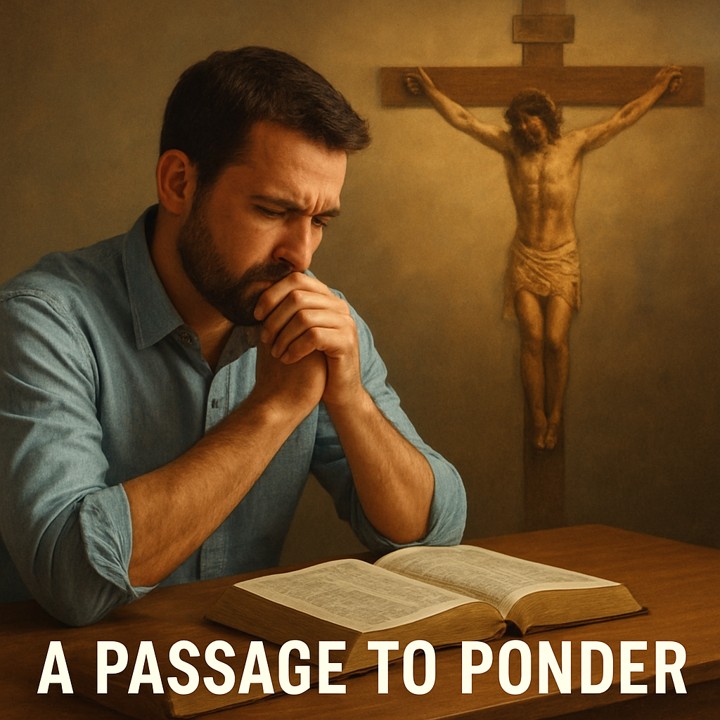
Years ago, a Christian businessman attended the funeral of a coworker he had known for many years. As the service went on, the preacher spoke warmly about the deceased man’s faith — how he had been a devoted follower of Christ, faithful in prayer, active in his church, and generous to those in need.
Afterward, as the man stood talking with others, a fellow employee turned to him and said, almost in disbelief, “Did you know he was a Christian? I had no idea!”
The businessman felt a sting of conviction. He realized that he, too, was a believer — but in all their years of working side by side, neither of them had ever spoken about their faith. Quietly, he thought, ‘No one ever knew it — about him or about me.’
That moment changed him. He resolved that, from then on, no one would have to wonder where he stood.
Today’s passage speaks of such a secret disciple — Joseph of Arimathea.
Following Jesus’ death on the cross, the apostle John wrote:
“After this, Joseph of Arimathea, being a disciple of Jesus, but secretly, for fear of the Jews, asked Pilate that he might take away the body of Jesus; and Pilate gave him permission. So he came and took the body of Jesus.”
All four gospel writers provide information about this intriguing character.
(1) He was a man of means. Matthew says he was rich. This is evidenced by his ownership of a rock tomb. Only the wealthy were buried in this fashion. Others received a regular burial.
(2) He possessed a position of influence. Power. Clout. Mark calls him “a prominent council member.” He was one of only 70 members of the Jewish Supreme Court. It was composed of Chief Priests, elders, and scribes. The presiding officer was the High Priest. So, Joseph occupied a unique place of honor. Respect. Esteem.
(3) He was a person of sterling character. Luke records that Joseph was a “good and just man.” Upright. Righteous. Virtuous. He disagreed with the decision to execute Jesus.
(4) Joseph was a religiously minded man. He knew something of the law and the prophets. The promise of the Kingdom. Both Mark and Matthew wrote that “he was waiting for the Kingdom of God.”
Yet, mingled in with the blasphemers, revilers, and mockers was Joseph. He stood there with mourners — Mary, John, and Mary Magdalene. He saw the rebellious robber and the repentant robber. He interacted with brutal Roman soldiers. He was even there on the Jewish Council when the vote was taken to condemn Jesus. He abstained. But silently so.
Because Joseph “feared the Jews,” he was a secret admirer. A hidden devotee. A private believer. But now he comes out in the open. His cowardice gives way to courage. His fear to faith. His reluctance to act. He boldly requests the body of Jesus from Pilate and properly and gently prepares it for burial. And who is there to help? None other than Nicodemus, another council member who once secretly came to Jesus by night.
These two powerful men, reluctant in Jesus’ life, become responsive in his death. And occupy an important place in fulfilling Isaiah’s prophecy. (Isa. 53:9). They risk the friendship of Pilate. They put their position on the council in peril. They endanger their standing among the Jews.
In addition, they spare no expense to bury Jesus. Nicodemus brought fine linens and 75 pounds of myrrh and aloes. An amount usually reserved for royalty. And in this case, it was. The King of Kings.
I wonder how many Christians are secret disciples? Silent believers? Closet Christians? Do your fellow workers know you’re a Christian? Do your neighbors? Do those in your social circle? Or other members of your club? Do you fear criticism? Rejection? Loss of prestige?
May the narrative of Joseph embolden you. To make your faith public. To come out of hiding. To stand up. To speak out. To temper your fears with courage. To take a stand for Jesus. To confess Him as Christ. To minister to Him and for Him.
True disciples cannot be secret disciples forever. Joseph reminds us that it’s never too late to step out of the shadows into the light and openly honor the Savior. Jesus promised. “Whoever acknowledges me before others, I will also acknowledge before my Father in heaven” (Matthew 10:32).
D. L. Moody offered this significant observation. “There are many who would be Christians in secret, but secret discipleship will destroy discipleship. Either the secrecy will kill the discipleship, or the discipleship will kill the secrecy.” Which will it be for you?
–Ken Weliever, The Preacherman
 ThePreachersWord
Pingback: Weekly Recap: November 10-14 | ThePreachersWord