
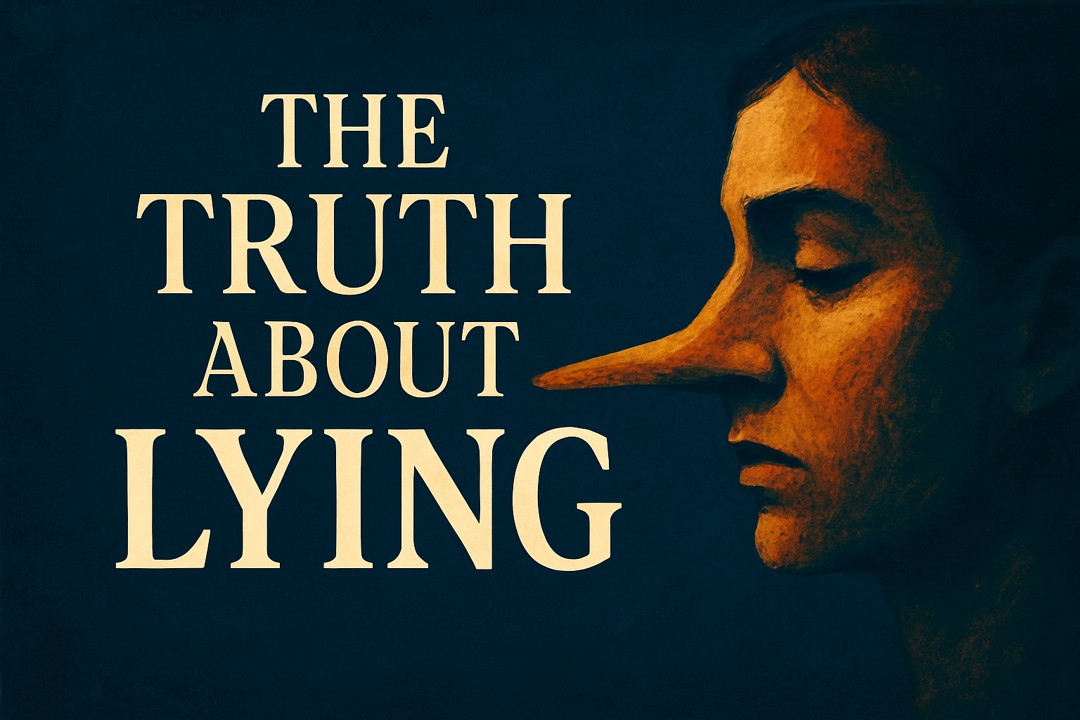
My good friend and preaching colleague, Steve McAllister, texted me recently saying, “thought this might be of interest for your blog on April 30th.
Attached was an article by Mike Riley entitled, “Do We Really Need A National Honesty Day?
Yep. I checked it out and according to the National Day calendar of unusual holidays today is National Honesty Day.
I learned that M. Hirsh Goldberg, the author of The Book of Lies, created this day in the early 1990’s. He thought it was a fitting contrast to April’s Fools Day on the 1st when all sorts of foolish pranks, jokes, and lies are told. He suggested we end the month on “a higher moral note.”
The calendar’s website offers this explanation.
We know the different kinds of lies. We’ve spared someone’s feelings or fudged the truth just a little or maybe told an all-out whopper. Unless we walked on water, we’ve all told a lie or two.
This observance encourages truthfulness. Whether we’re conducting business or speaking with our children, honesty goes a long way toward instilling confidence. We all make mistakes. Sometimes, we don’t know the answer or can’t control the outcome of a situation. However, we can control our own actions and words. And we can speak the truth in all we do.
Celebrate the day by answering questions truthfully all day long. Use #NationalHonestyDay to share on social media.
Riley observed in his article that it’s “a sad commentary on society that such a holiday should even be considered, much less established.”
Mike’s right. I can remember my Dad in the 1950’s and 60’s doing business with local farmers with a verbal commitment and a handshake. It was a time when one could say “my word is my bond.” Such an affirmation spoke to one’s reliability. Credibility. Integrity. And honesty.
It’s interesting how the web page invokes euphemistic expressions for lying like ‘fudged the truth” and “whopper.” Think of the other ways people try to diminish lying.
- Economical with the truth.
- Stretching the truth.
- Bending the truth.
- Half-truth.
- Telling a tall tale.
- Being creative with the facts.
- Misspoke.
- Alternative facts.
- Selective amnesia.
- Spin.
- Fib.
- Equivocate.
- Fabricate.
- Not entirely accurate.
- White lie.
Obviously, many folks like to soften this sin with these and other such expressions. The Bible, however, is more direct and explicit with these warnings describing a liar.
- Lying lips (Prov 12:22)
- Lying tongue (Prov. 6:17).
- Falsehood (Prov. 30:8).
- False witness (Prov. 19:9).
- Deceit (1 Pet. 2:1).
- Guile (I Pet. 3:10).
- Hypocrisy (Matt. 6:2,5,16).
From these passages we learn that lying is an abomination to God. He hates and abhors it. It is opposed to His nature, contrary to His character, and the antithesis of His holiness.
Furthermore, lying originates from Satan, the father of lies (Jn. 4:44). Lying ruptures relationships and destroys trust (Prov. 26:28; Col. 3:9). And lying will bar you from heaven, sending you to hell (Rev. 21:8).
Walter Scott was right when he wrote, “Oh, what a tangled web we weave, when first we practice to deceive!”
Instead of a National Honesty Day, we need national honesty as a lifetime pursuit. Politicians, parents, preachers, and all people ought to heed the Bible injunctive “put away lying, and let each one of you speak the truth with his neighbor” (Eph. 4:25).
Like any sin, lying can be forgiven when we repent of it (1 Jn. 1:8-10).
Finally, the advice of Mark Twain rings true. “If you tell the truth, you don’t have to remember anything.”
–Ken Weliever, The Preacherman
 ThePreachersWord
Pingback: Weekly Recap; April 28-May 2 | ThePreachersWord