
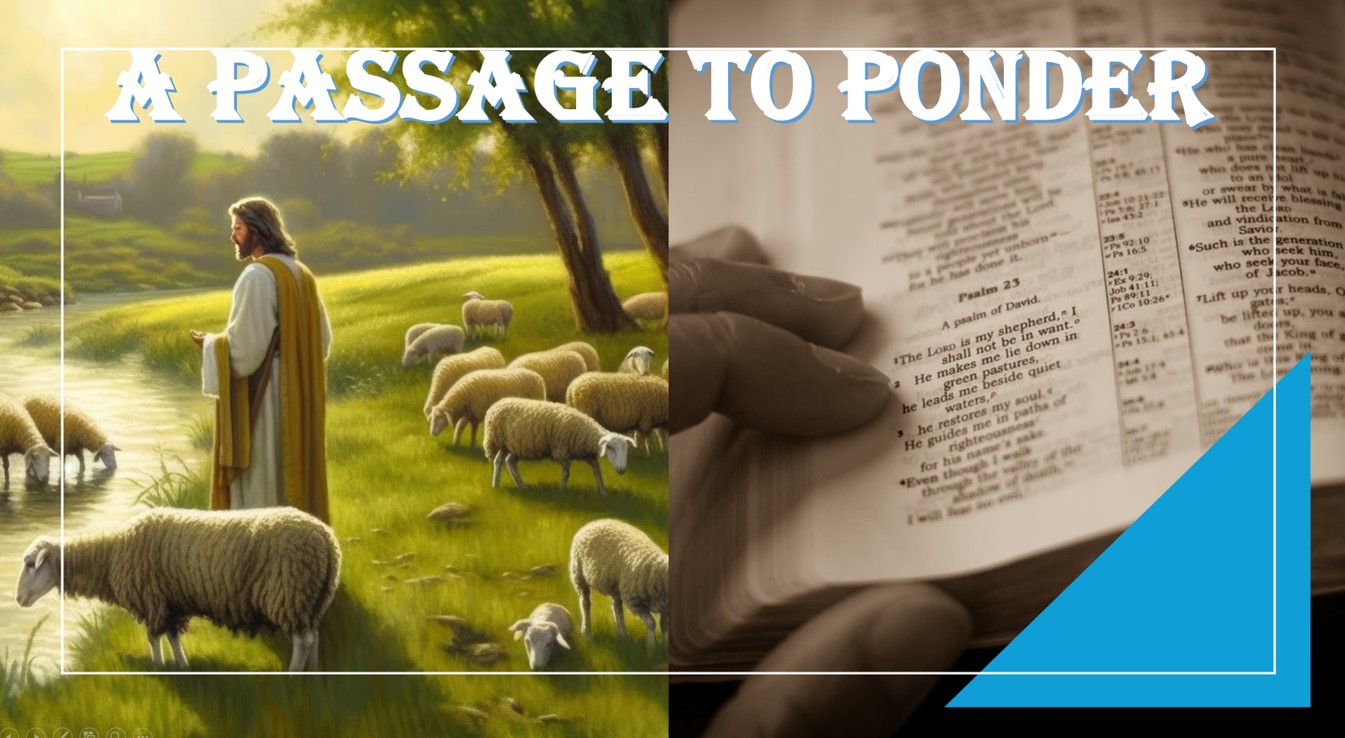
“Surely goodness and mercy shall follow me
All the days of my life”
The theme and thesis of this entire Psalm has been devoted to the fact the shepherd is providing for the sheep. And it’s all summed up in today’s statement.
The sheep cared for by the good shepherd enjoy a special, privileged position. They are safe. Secure. And sheltered. They are protected from every predator, all harm, and even their own foolish missteps. They are calm, tranquil, and at peace in the flock.
Furthermore, at the end of the day the shepherd could look over his sheep and feel good about the care he was providing and the condition of the sheep. He is a good, merciful, and thoughtful shepherd who anticipates and tends to their needs.
The metaphor and parallel was evident to David and is not lost even on modern day disciples. In Psalm 78:52 David affirmed Jehovah’s shepherding capacity. “But He made His own people go forth like sheep, And guided them in the wilderness like a flock.” Indeed, we are God’s people; the sheep of His pasture (Ps. 79:13).
Consider the Psalmist’s affirmation in connection with Jesus’ pronouncement “I Am the Good Shepherd” (Jn. 10:11-14). Specifically, note the import of each word.
Surely.
There is conviction, certainty, and surety that the Good Shepherd will provide for our every need. Conviction involves our faith and trust in His promises. Indeed, “faith is the assurance of things hoped for, the conviction of things not seen” (Heb. 11:1).
Goodness.
This is an often used description of God’s nature, personality, and character. Thus, “every good and perfect gift” proceeds from “the Father of Lights” (Jas. 1:18). Jesus’ Deity allowed Him to also affirm His goodness as “The Good Shepherd.” His loving-kindness, graciousness, and care of His people is clearly evident.
Mercy.
Merciful is another word often depicting God’s attitude toward His people. Statements like this can be found throughout the Old Treatment. “The Lord is merciful and gracious, Slow to anger, and abounding in mercy” (Ps. 103:8). Grace gives us what we don’t deserve, but mercy withholds what we do deserve. As wayward sheep we deserves punishment, censure, and condemnation, but the Good Shepherd with a heart of compassion offers mercy.
Follow me.
The Brown-Diver-Briggs Hebrew lexicon says the word translated as “follow” (radaph) actually means “to pursue…to chase…to run after.” The Good Shepherd is actively pursuing His people. Not just in the past, nor in the present, but He will in the future as well. Jesus wants us to be in the sheep fold. To hear His voice. To follow Him. And, as in the parable of the lost sheep, He will actively seek to restore us to the fold. What a blessing! What a comforting thought!
All the days of my life.
David could attest to God’s continued care for him in good days and bad days. In victory and in defeat. In the wilderness and in the palace. In times of faithfulness and even in times of waywardness, God did not forsake David, but sought his repentance and return. That’s The Good Shepherd’s promise to us. “I will not leave you or forsake you” (Heb. 13:5).
One final application.
Since elders in the church are called “Shepherds” who are commanded to tend God’s flock, these attitudes and attributes ought to be demonstrated in their leadership as they watch and provide for the sheep entrusted to their care.
Today’s pastors are not to be hired hands with merely a title who are in it for themselves and whatever power, prestige, or pay they receive. They are not cowboys driving cattle with a whip. They are not sheriffs flashing their badges, banishing guns, and looking for violators of the law to punish. Nor are they CEOs or CFOs making decisions behind closed doors issuing edicts and policy decisions with little regard for the people. They are good and merciful shepherds. Leading. Serving. Caring. Providing. And nurturing.
Our Good Shepherd, in the words of F. B. Meyer, offers “Goodness to supply every want. Mercy to forgive every sin. Goodness to provide. Mercy to pardon.”
–Ken Weliever, The Preacherman
 ThePreachersWord
Pingback: Weekly Recap: March 31-Apri 4 | ThePreachersWord