
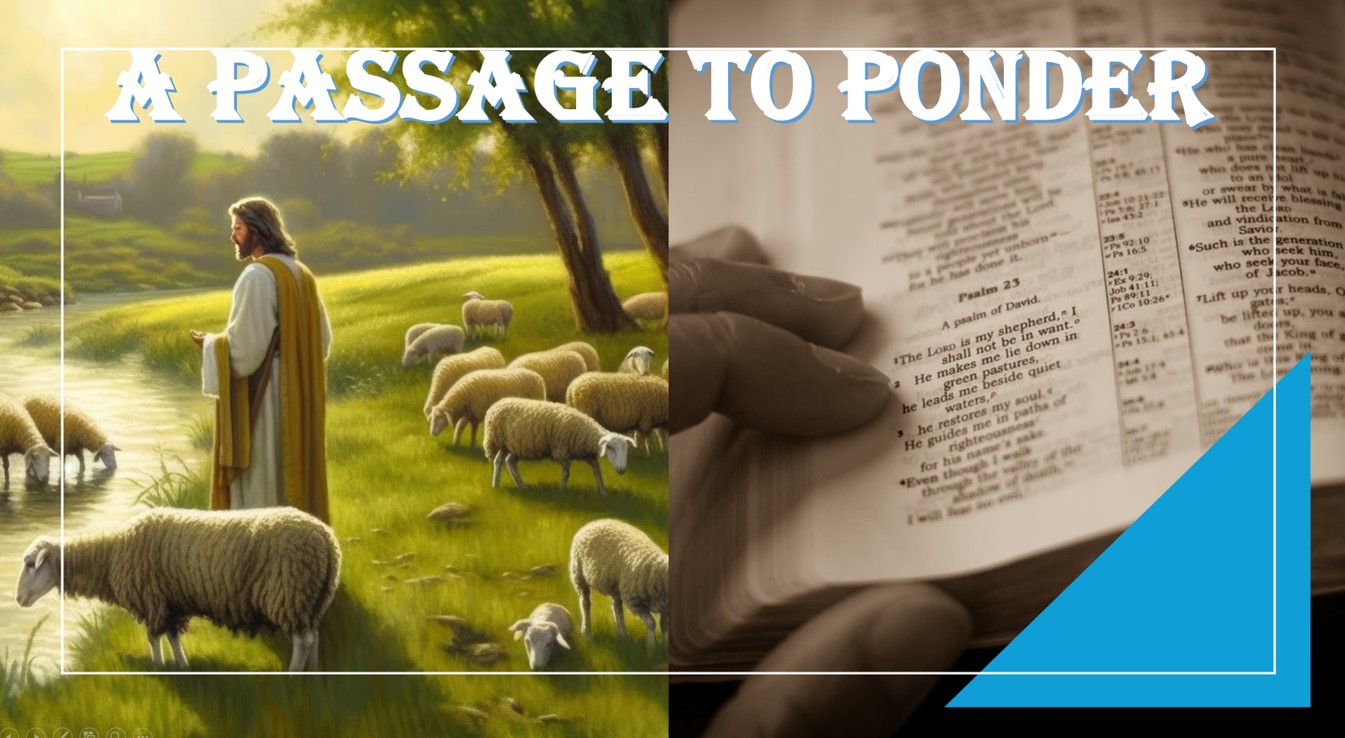
“He leads me beside the still waters.”
Peace. Calm. Rest. Tranquility. These are words that embody the imagery of “still waters.”
As noted in earlier posts, sheep, by their very nature, are very timid and fearful animals. They are not good swimmers. So, they are afraid of rushing water. Of course, if you were trying to swim wearing a heavy wool coat, you’d probably be a bit fearful as well.
Furthermore, Phillip Keller, in his book, A Shepherd Looks at the 23rd Psalm, offers this insight.
“When sheep are thirsty they become restless and set out in search of water. If not led to the good water supplies of clean, pure water, they will often end up drinking from the polluted pot holes where they pick up such internal parasites as nematodes, live flukes, or other diseases.”
Thus, the shepherd will lead them across mountains and valleys looking for a nice, quite, calm stream where they can quench their thirst. Note, again the language. “He leads me…” He doesn’t try to force the sheep, or drive them, or just point the way. Neither does he throw up his hands in exasperation. “He leads…”
In a similar way, we’re reminded that Jesus, The Good Shepherd, leads us to a place of serenity, calmness, and tranquility. When we trust the leadership of the Shepherd, we will be free from the extreme burdens and anxieties of life. We find reassurance in his promise, “Do not worry about tomorrow; for tomorrow will care for itself” (Matt. 6:34).
The Good Shepherd provides spiritual peace, renewal, and comfort. As a result, we are able as Peter penned to cast our cares upon Him because He cares for us (1 Pet. 5:7). Thus, with the hymnist, Horatio Spafford, we confidently affirm “It is well with my soul.”
This metaphor also reminds us that like sheep, God knows our limitations. He does not ignore or mock our fears. He understands our weaknesses. He realizes the frailty of our flesh. He does not dismiss the infirmities of our humanity. Indeed the Psalmist offers this comforting insight.
As a father shows compassion to his children,
so the Lord shows compassion to those who fear him.
For he knows our frame;
he remembers that we are dust.
–Ps. 102:13-14.
The Good Shepherd does not force to go where we cannot safely go. He never demands more of us than we are able to accomplish. He is patient. Tender. Compassionate. And gentle.
Like sheep need water to survive, we also need the “water of life” to sustain our souls. The Shepherd doesn’t want us to drink from the polluted streams of carnality, secularism, hedonism, human philosophy, or pseudo-science. Jesus proclaims, “If anyone thirsts, let him come to Me and drink” (Jn. 7:37).
Both our need for spiritual refreshment and the ability of the Good Shepherd to quench our soul’s thirst, is a metaphor and theme often portrayed by the Psalmist.
Ps 36:8
They are abundantly satisfied with the fullness of Your house,
And You give them drink from the river of Your pleasures.Ps 42:2
My soul thirsts for God, for the living God.
When shall I come and appear before God?Ps 63:1
O God, You are my God;
Early will I seek You;
My soul thirsts for You;
My flesh longs for You
In a dry and thirsty land
Where there is no water.
What a beautiful thought and such a serene scene to picture our Shepherd leading us beside the still waters. It reminds us of the familiar hymn by Joseph Gilmore.
Sometimes mid scenes of deepest gloom,
sometimes where Eden’s flowers bloom,
by waters calm, o’er troubled sea,
still ’tis God’s hand that leadeth me
He leadeth me, he leadeth me;
by his own hand he leadeth me:
his faithful follower I would be,
for by his hand he leadeth me.
–Ken Weliever, The Preacherman
 ThePreachersWord
Pingback: Weekly Recap: February 10-14 | ThePreachersWord