
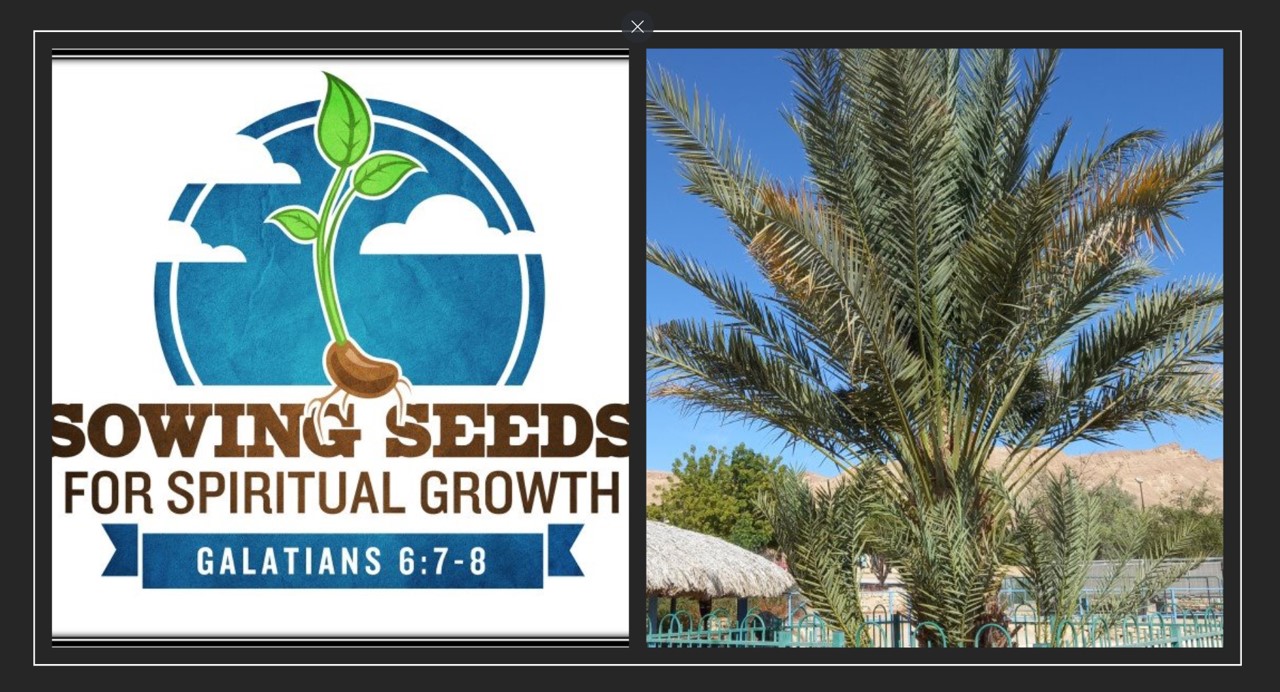
Methuselah is said to be alive and flourishing. No, not the ancient antediluvian in Genesis, but a date palm tree grown from a 2,000 year old seed.
According to Smithsonian Magazine, as well as National Geographic, the antique seed was discovered at the remains of Masada, an ancient fortification perched on a rock plateau in southern Israel.
The seed was planted and has grown into a flourishing tree. A 2022 article in The Jerusalem Post says Methuselah (pictured above) is now 4 meters tall. Also it has pollinated a female tree and is producing dates.
This story reminds us of the untapped potential that lies within all of us. Seeds of greatness that may have been lying dormant that can germinate, grow and produce fruit to bless others and glorify God.
Novelist H.G. Wells once said that “wealth, notoriety, place, and power are no measures of success whatsoever. The only true measure of success is the ratio between what we might have been and what we have become. In other words, success comes as the result of growing to our potential.”
In his book The Success Journey, John Maxwell, wrote, “Reaching your potential is part of the secret of success. God has invested substantially into your life. Whether or not you bring a return is dependent on growing in your potential.”
The New Testament letters often encourage Christians to do more. To improve. To grow. To increase. To the Thessalonians, Paul admonished, “may the Lord make you increase and abound in love for one another” (1 Thess. 3:12). In his second letter to them, Paul said “your faith is growing abundantly, and the love of every one of you for one another is increasing” (2 Thess.1:3).
The words “increase” and “abound” are similar in their meaning. They speak of a superabundance. Of overflowing. Of multiplying.
The apostle Peter exhorted Christians to add to their faith moral excellence. Knowledge. Self control. Perseverance. Godliness. Brotherly Kindness. And love. He then added, “For if these qualities are yours and are increasing, they keep you from being ineffective or unfruitful in the knowledge of our Lord Jesus Christ” (2 Pet. 1:8).
Growing in these virtues increases our mental, moral, emotional and spiritual capacity. In The 15 Invaluable Laws of Growth, John Maxwell calls this “The Law of Expansion.” “Growth always increases your capacity,” Maxwell writes.
Among the many lessons from Jesus’ parable of the Talents is that we can increase our capacity. The five talent man doubled his talents. So did the two talent man. The master entrusted these men with his treasure because he saw their potential to grow and expand. The one talent man, while he lacked ability, was not excused for his failure to perform. He was condemned because he failed to do what he could do.
We too often sell ourselves short, or make excuses for our lack of growth. Yet we possess the potential to do more, and to become more than we are. This point always reminds me of that poignant scene from the classic movie, Lion King. King Mufasa had died. His son, Simba, was living a life of leisure, avoiding his responsibilities, and failing to take his rightful place as Ruler of the Pride Lands.
Speaking from beyond the grave, Mufasa speaks to his son in a vision and says, “Simba, you have forgotten who you are. Look inside yourself. You are more than what you have become.”
I wonder if the Lord might be saying the same thing to us. Have you forgotten who you are? You’re a Christian. A disciple. A pupil. A learner. A follower of Jesus. Examine your heart. Your life. Your growth. Don’t you know that you can be more than you are now?
The Irish born playwright George Bernard Shaw was interviewed by a reporter shortly before he died and asked, “Mr. Shaw, If you could live your life over and be anybody you’ve known, or any person from history, who would you be?”
“I would choose,” replied Shaw “to be the man George Bernard Shaw could have been, but never was.”
What about you? And me? Are we becoming that person that we could be, and the Lord wants us to be?
–Ken Weliever, The Preacherman
 ThePreachersWord
Amen! 🙂
LikeLike
Pingback: Weekly Recap: November 27-December 1 | ThePreachersWord